

Will Guyeskey is Director, Digital Product at GoPro. He began his career as a project supervisor at Williams Group, a strategic communications agency. Will then transitioned to Blazer (acquired by MERGE) as a consultant in digital experimentation and personalization. Before his current position at GoPro, he served as Senior Manager, Digital Transformation Strategy at Gap Inc.
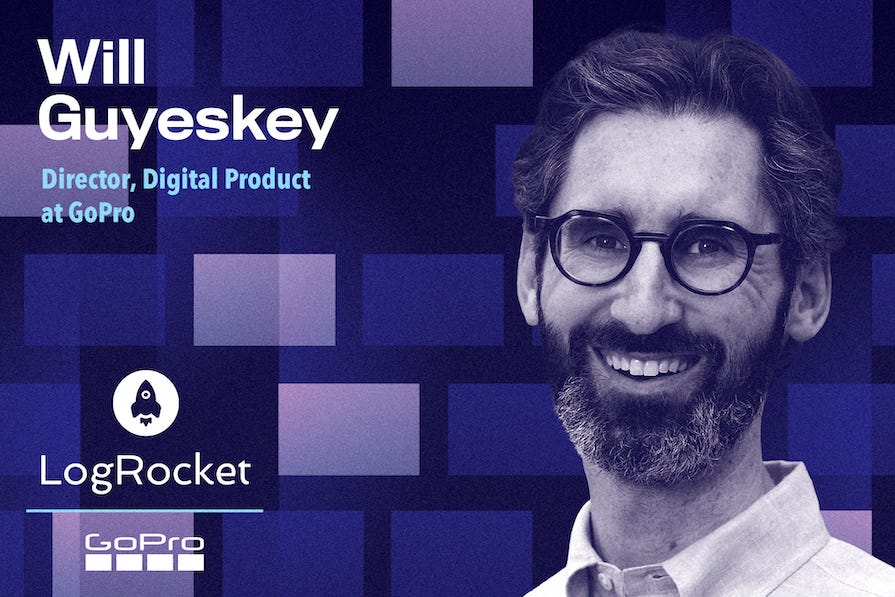
In our conversation, Will discusses how experimentation evolves as organizations scale and why leadership mindset is the foundation of a successful experimentation culture. He talks about how GoPro reduced time-to-market while creating more capacity for experimentation, and shares his learnings from unexpected outcomes.
Building an experimentation culture
You’ve had experience in experimentation programs from several vantage points — as a consultant, as a transformation leader at Gap, and now leading GoPro’s Digital Product team for the ecommerce site. From your perspective, what’s changed about what makes experimentation successful?
The first thing that comes to mind is my early days as a consultant. I was fortunate to work at a boutique agency that specialized entirely in experimentation and personalization. We worked with organizations like Barnes & Noble, Ralph Lauren, Under Armor, and Fidelity.
At first, it was hard to understand what test to run and where to start. It was very confusing until I realized it really comes down to the customer. Every organization has unique customers who expect different things and want different experiences. The thread that’s remained the same throughout my career is understanding the customer and meeting their needs.
One thing that’s changed is my perspective on scaling. As a consultant, I used to think, “Why don’t these companies just double their experimentation output? We could go from four tests a month to eight tests a month tomorrow.” Then I worked at Gap, with four global brands, and now at GoPro. You realize the complexity of the organization itself often becomes the blocker to increasing experimentation velocity. As a consultant, I had the luxury of focusing on one objective. Within a large organization, you appreciate just how much coordination is required to scale experimentation.
When you’re driving experimentation, at what point does it become part of the culture?
I think a really important factor is leadership’s disposition toward data and experimentation. I’ve worked with leaders who know experimentation very well and are really gung-ho about it from the beginning. I’ve also worked with leaders who don’t have much experience but quickly understand the logic behind it. In both types of organizations, experimentation thrives.
Where it gets difficult is with leaders who have been in the business for a long time and think they already know how it works. They have a roadmap from past experience and come in ready to check the boxes because they believe they already know the outcome. In that kind of environment, there’s less room for experimentation.
Experience can absolutely inform decisions, but there’s got to be a real humility around the uniqueness of each organization. What worked somewhere else — or even what worked before in the same org — doesn’t necessarily translate to the current situation. That’s where experimentation becomes much harder to gain traction.
Many organizations say they want to be data-driven, but still make roadmap decisions based on the loudest voice in the room. What separates companies that run experiments from those that make decisions through experimentation?
I think the difference is what I call a culture of experimentation. That means making experimentation visible to everyone. Everybody can submit ideas and guess which experiment will win. Everybody can see the results. Sometimes that’s through emails or polls, and sometimes through more formal meetings or forums. Not everyone participates, but that openness and transparency are really important. In organizations that embrace that mindset, experimentation starts to replace the loudest voice in the room.
Learning from unexpected results
Throughout your career, you and your teams have driven significant improvements in conversions, engagement, and customer satisfaction. Can you share an experiment or product decision that surprised you?
Sure, there was one experiment that almost didn’t happen because so many people thought it wasn’t worth testing. The idea was to add a recommendation carousel to the order confirmation page. People said, “They’ve already made a purchase. Why would they buy again?”
What got people on board was the strategy behind it. There is no point during a visit when you know more about a customer than after they’ve completed a purchase. You know what they browsed, what they bought, how much they spent, and whether they’ve been there before. This was for Barnes & Noble, where the average order value is relatively low. We ran the test, and it produced a statistically significant increase in revenue. As far as I know, it’s probably still on their site today.
Again, it comes back to understanding the audience. These are readers — they’re much more likely to add another book to their order than someone who buys a product only once.
On the product side, one of the biggest changes at GoPro was the introduction of an NPS score for our ecommerce site. We had already measured NPS for our customer service call center, but we hadn’t measured it for the website experience itself. We implemented a quarterly NPS survey, and that gave us a consistent benchmark for the site’s experience. When the score improves or declines, we can pair it with behavioral analytics to understand why.
Your team has also significantly reduced time-to-market. How did you accomplish that?
It was a very focused effort, and I’d like to give credit to our principal product manager, Brandon Watts, who led much of this work. We started with a survey asking teams which parts of their work took the longest and how much time product launches required across UX, Merchandising, Engineering, and Studio.
The responses quickly pointed to one bottleneck in Merchandising. Creating product detail pages inside our CMS required navigating six or seven layers just to add images or content. We focused our effort there. By simplifying that workflow, we reduced the time required to create those pages by more than 50 percent, which was a huge win for the team. The Merchandising team now has more time to focus on higher-value work, including experimentation.
Scaling experimentation across organizations
At Gap, you had four distinct brands under the company umbrella, including Banana Republic, Athleta, and Old Navy. How does experimentation change when you’re optimizing for a diverse portfolio of customers vs. a single, deeply engaged community like at GoPro?
GoPro has one experimentation program with a tight group of stakeholders across Product, Merchandising, Studio, and Engineering. Because we all understand the same customer, company strategy, and KPIs, we can move very quickly.
Gap was very different. I led the personalization pillar across Gap, Banana Republic, Athleta, and Old Navy. Those customer personas are completely different. A win for Old Navy — something like promotional badging or urgency messaging — fits naturally with that brand. The same experience could feel completely out of place at Banana Republic and even weaken the brand.
That’s one of the biggest differences when you’re scaling experimentation across multiple brands. It’s not just about finding wins. It’s about getting stakeholder alignment while respecting each brand’s identity.
Many experimentation programs optimize conversion or click-through rate. How do you make sure teams are improving the overall experience?
I’m still surprised when I see roles focused exclusively on conversion rate optimization. Conversion isn’t the end-all metric for retail organizations. It’s actually fairly easy to increase conversion if you’re willing to sacrifice revenue. A retailer could push more people to buy less expensive accessories rather than higher priced flagship products. Conversion might improve, but the business will lose overall. The right KPI drives the right improvements. One metric I really like is revenue per visitor because it combines revenue and traffic into a single measure. It accounts for changes in average order value and conversion together, rather than optimizing one at the expense of the other.
I’ve also become a big believer in measuring NPS directly on the website. Customer lifetime value can also be valuable, but it’s less clear cut. Organizations calculate it differently. The important thing is making sure the calculation actually reflects the holistic value of your customers to your business.
AI, strategy, and scaling responsibly
As AI makes experimentation faster and cheaper, how do you distinguish productive experimentation from experimentation theater?
It comes back to strategy. Whether a test wins, loses, or ends up flat, you should learn something from it. If you’re not generating insights regardless of the outcome, you’re probably not spending your time wisely.
The second part is ensuring you can sustain the winning experience. Organizations often realize they can personalize experiences for 15 different customer segments. That’s exciting until you ask what it means for UX, Merchandising, Localization, Engineering, and Studio.
Before we run a test, we ask whether the winning experience is something we can realistically maintain over time.
Lastly, what’s the biggest mistake leaders make when trying to scale experimentation?
The biggest mistake is shortchanging strategy or analytics. AI can generate fifty creative variations in seconds. The bottleneck isn’t producing assets anymore, but if your tests aren’t strategic — if they aren’t designed to teach you something regardless of the outcome — you’re moving too fast.
The same applies to analytics. If your analysis starts to degrade because you’re running too many experiments, or you’re no longer using those insights to shape future tests, you’ve scaled beyond what the organization can support. The moment strategy or analytics begin to decline, I’d pause any further scaling.
What does LogRocket do?
LogRocket’s Galileo AI watches user sessions for you and surfaces the technical and usability issues holding back your web and mobile apps. Understand where your users are struggling by trying it for free at LogRocket.com.