

Scott Molvar is Senior Vice President of Product Management at YouVersion, a free digital Bible platform. He began his career in web development at Frontera Corporation before transitioning to program management at Xdrive, an early cloud storage company. From there, Scott held various program manager roles at Ticketmaster, Expedia, and Microsoft. Before his current position at YouVersion, he led product teams at JV Systems, Porsche E-Bike Performance, and Bugatti Rimac.
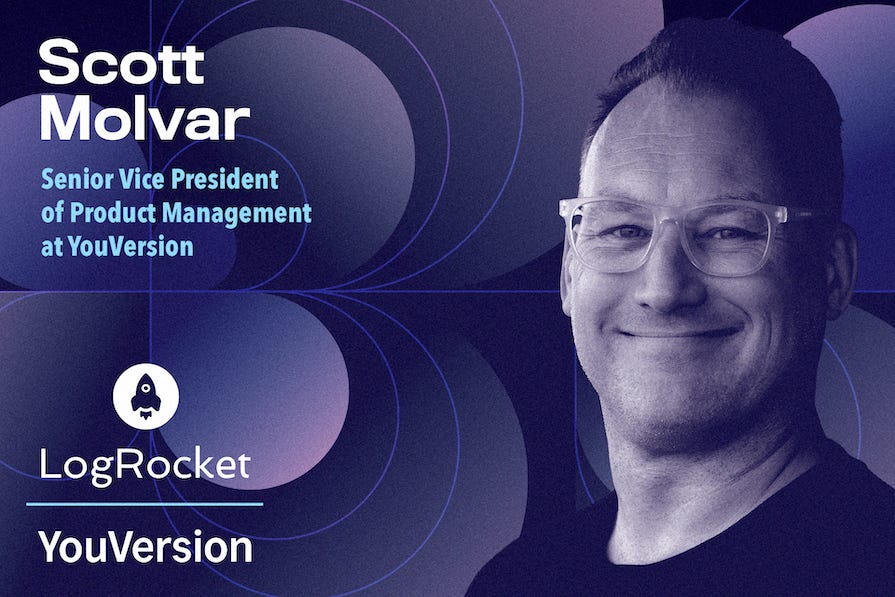
In our conversation, Scott shares why empathy is the foundation of great product management and how the simple mantra, “I am not my customer,” has shaped his leadership philosophy throughout his career. He discusses balancing user research with data, preserving empathy while building products at YouVersion’s global scale, and where AI can — and shouldn’t — play a role in product development.
Understanding people before building products
You’ve led products that range from booking travel to designing hypercar experiences to helping people build spiritual habits. What have those very different products taught you about human behavior that you think every product manager should understand?
The products and experiences I’ve been involved in are wide-ranging, but I think there’s a common thread among them. In the end, people come to a product or service because they have a need they can’t meet themselves, or they’re looking for expertise to meet that need.
In travel, it’s much less about the destination and more about the experience. In hypercars, it was about the quintessential thing that could not be had that’s customized or unique. In my current role, people come to Scripture or faith with a particular desire, history, or path, and they’re looking for something. Everyone’s on a journey, and whether you make a physical product or a service, the idea is that someone invites a product or service into their life because they’re looking for something from it.
In the age of AI, as automation gets good enough to deliver a flawless product experience, what human function can still not be automated away?
This is such a big topic right now — not a day goes by without some kind of conversation about what the future of product management looks like. While I believe AI experiences and automations will improve, I still haven’t seen where taste meets function. It’s very hard to understand good taste from bad taste, or appropriate responses, questions, or ways to deal with a situation.
If you’re coming to something and you say, “I have anxiety, and I need help,” there’s a different response than, “I want the fastest hypercar in existence.” Being able to contextualize your responses and build products with those human needs or desires in mind is something I don’t know will ever be automated.
The fun part is that you can now try more options or have more experiments. We don’t necessarily have to get it right the first time. We can try three, four, or five times for a much lower price or with much less energy spent. I look forward to bringing the right tone, the right experience, good taste, and simplicity, while also being able to go up to bat multiple times at a lower cost.
When you’re trying to understand what customers actually need, how do you separate what they’re asking for from the underlying problem they’re trying to solve?
It’s nuanced because sometimes what people say in a user interview doesn’t match the behavior you see in the data. Someone might say, “I want X, Y, and Z,” and then, when you observe their actual behavior, they want something different.
At every organization I’ve worked at, we’ve spent a lot of energy on user research, putting that alongside the data, then measuring and analyzing them together. If you bring only one or the other, you don’t have the whole story.
I’ve also learned not to ask direct questions about particular products. It’s tempting to ask, “Do you like the thing that we made?” But it’s better to ask, “How did you get here? What made you step in this door?” Learn the why before the product. I tend to go back one or two steps, and that’s usually where the real nugget of information is.
Understanding what customers need from a product requires empathy. What does empathy mean to you before it becomes anything on a product roadmap?
To me, empathy means being able to think about someone else — or their experience — in your day-to-day life. For example, how does what I’m doing impact others? What are others around me thinking, feeling, or responding to as I work or live?
‘I am not my customer’
Did you have a moment in your career that taught you the importance of user empathy?
I definitely experienced this during my time at Expedia. One of Expedia’s policies was that you go to the call center and listen to people who had called in — because that meant that something had gone wrong with their vacation, like a delayed flight or extra, unnecessary charges. If you ever want to feel terrible, listen to people talk about how their dream vacation had a problem! That was the beginning of my journey to really understand how much emotion is tied to the product.
As we spent more time in the call center and with user research teams, the phrase “I am not my customer” cropped up. We all had an aha moment around this and even made T-shirts that we wore in the office that said, “I am not my customer.”
I’ve carried that with me ever since. If I’m not careful, I end up designing products for myself and don’t represent the buyer or customer. That’s become a mantra for me: “I’m not my customer. I need to remember who they are.”
Are there any rituals you use with your team to reinforce that idea?
Bringing in perspectives is important. At YouVersion, I like to start team meetings with stories and feedback that we get from people who’ve had either a great experience or a bad experience. Anyone can bring one. It grounds us in everything we’ll talk about afterward. If we’re too tactical, we’ll keep building things for ourselves. If we start with the story of someone whose life was changed — or someone whose life was put out or uncomfortable — by what we did, it grounds us in remembering who we do it for.
Empathy can often be at odds with hard metrics, like retention. How do you keep your team empathetic while still managing outputs?
We have an internal phrase: “Data has a seat at the table, but it doesn’t occupy all the seats at the table.” Every time we come to the table with data, we also come with research. Then we ask what we’re actually trying to do. Is the data helping us accomplish the job to be done, or is it steering us toward an imaginary goal?
Data has a seat at the table, as does research. The overall “why?” belongs there too. Data is a tool — one of many in the toolbox. We’re much better at getting data than we’ve ever been, but I don’t think it tells the complete story.
Scaling empathy without losing the individual
At a scale of a billion downloads on YouVersion, how do you keep the user from becoming an abstraction you’re optimizing against rather than a person you’re building for?
This has been the most demanding and meaningful stretch of my career for that reason: people approach the Bible and faith with so many different contexts, life experiences, backgrounds, and emotions. There aren’t two personas or four — there are thousands of reasons someone showed up.
We try to remember that people carry something in with them when they walk through the front door, and it’s our job to understand what that is. We started asking, “What brings you here today?” It’s something you might experience in a boutique shop or an old hardware store where service is prime. Someone asks, “What brings you in today?” Then they can respond, “I’m looking for this really rare thing.”
That’s our job in a growing digital business: keep remembering to ask people, “What brings you in today?” in a digital way and then respond as well as we can. We’re not there yet, but that’s our target.
Users also want to get where they’re going quickly. How do you balance speed of the experience with building trust?
I love that I’m a beneficiary of where we are in this space right now — it used to be considered intrusive to ask people questions when they first walked in the door. But we’ve learned that if you go shopping right away in the digital space, we’ll have a hard time helping you find what you need unless we can ask you questions first. The expectation has changed. People are willing to invest a little time up front to have an experience that looks built for them and that addresses them.
We’re really front-loading the dialogue we all want. We all want a custom experience. We didn’t know how to get there, and people didn’t know how to tell us what they wanted. Now we can ask, “What brought you in the door? Is there a goal you have in mind?” “How can we help you meet that goal?” It’s building a relationship in a new digital way.
What’s your method for staying in direct contact with what one real person feels using the product?
At all the places I’ve been in my career, there has either been an insider or VIP program, or we’ve created one. This is where you find people who are excited about what you’re doing and build relationships with them. It’s a little easier in the physical product space. For example, in the hypercar space, it was just a few people — we could have constant contact with them.
At YouVersion, we recently invited longtime users into an insider program. Once a month or so, we’ll ask them questions through surveys, and some of those lead to video conversations. We have maybe 10 or 12 people that, when we think of something or we’re not sure about it, we’ll run it by and ask, “What do you think?” They’re honored to be part of the process, and we’re honored to get another perspective so that, in fact, I’m not my customer.
The harder part is that I don’t get as much contact as I’d like with the people who have decided to do something different or have moved on. We spend more energy, more time, and more dollars trying to understand that group because that’s who I would love to have more contact with.
On the flip side, how do you instill user empathy in product managers who will never personally talk to more than a sliver of the people they’re building for?
Five years ago, I wouldn’t have told you it was this simple, but now it’s about staying as close as you can to the stories and being a great storyteller. I feel like it’s absolutely part of my job as a leader to tell the stories of the people — good and bad — who have interacted with our products.
That’s why I kick off team meetings with stories, and everyone’s encouraged to bring one. We bring the embarrassing ones and the great ones.
It’s easy to lose perspective on the impact of what you’re doing. Storytelling brings you back to that moment when someone’s life changed, when they found exactly what they were looking for, or when they found a great product. It also means getting better at retrieving those stories and cataloging them. Thankfully, in the app world, you have App Store reviews, but there are other places where you can gather those conversations. I don’t think we can ever be too far away from the stories of the people we serve.
Where AI fits into faith-based products
At YouVersion, where have you drawn the line for integrating AI in the faith product?
This is an ongoing conversation. We’ve landed on the idea that tools that help us with workflow, do our jobs more efficiently, build context, catalog research, or draw correlations are areas where AI can help us. Those tools augment the human mind.
But at YouVersion, where we represent a biblical text that’s thousands of years old, we’ve been deliberate about not placing AI between a person and Scripture. If we ever move in that direction, it will be because we’re confident it can be done with the level of accuracy and integrity worthy of the text.
Where the text needs to be, the text is — with no apologies and no buffers. Where AI helps us remember things, organize research, or find correlations, we welcome it. Everything in the middle is a high-tension conversation that we often have.
How does your personal faith shape your work?
My personal faith shapes everything that I do because it’s who I am. The number one thing that gets me out of bed — and why I love product management — is helping people get where they want to go. In another life, I think I would’ve been a hotel concierge because I just love helping people get where they’re hoping to go.
My faith brings into that a desire to help people get where they’re going in their faith. When I’m not at work, I love having conversations with people about their personal lives, their faith journey, and what they’re looking for, and helping them find it in whatever way I can.
When we were building physical products, you could see the joy people got from being part of that journey. Likewise, we’re all on a journey, and for me the destination isn’t vague. It’s a real relationship with God. Faith is every part of that equation. For others, it’s still unfolding, and I count it a privilege to walk part of that road with them and point toward what I’ve found.
What does LogRocket do?
LogRocket’s Galileo AI watches user sessions for you and surfaces the technical and usability issues holding back your web and mobile apps. Understand where your users are struggling by trying it for free at LogRocket.com.