

Roger Portela is Senior Director of Product, Fintech, AI, Payments Optimization, and CX at PayNearMe, a platform transforming the payment experience for businesses and their customers. After spending his early career in the US Navy, he transitioned into technology consulting before joining Blackstone Merchant Services, Inc. as Director of Marketing and Product Management. From there, Roger served in leadership roles at companies such as GPShopper, a Synchrony Financial Company, and IDT Corporation. Before his current position at PayNearMe, he led product management teams at Boats Group, a marine marketplace platform, and Air Find, an adtech marketplace for publishers and telcos.
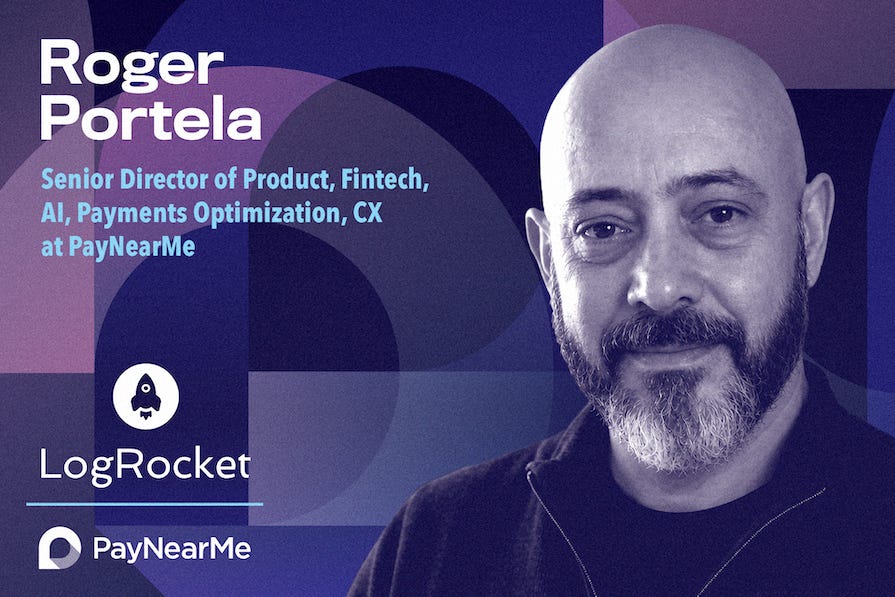
In our conversation, Roger shares his perspective on how AI is fundamentally reshaping the product management role, including the increasing pressure on PMs to operate at higher speed and scale. Roger discusses how his time in the US Navy has influenced his approach to leadership, and also talks about his prediction that the PM role is splitting into “builders” and “peopleers.”
How AI is redefining product management
How would you describe the disruption AI is bringing to the PM role right now?
It’s nothing we have ever seen in technology. AI is a monumental shift in the way that we work, in the output that we have, the outcomes that we can achieve, and everything in between. It is both empowering and disempowering at the same time. It depends on how deeply you go down the rabbit hole. Those who embrace AI and utilize it without it being a crutch are going to succeed. Those who buck the trend and refuse are going to get out of the industry or be forced out one way or the other. I don’t think there’s an in-between — the status quo is over.
There’s a lot of focus on the technical skills and tools PMs need to stay relevant in this AI era. What skillset do you think is being overlooked?
Language. Technical skills are still being played out. You don’t need nearly as many technical skills to build as you once did. A couple of years ago, if you wanted to build a website, you’d go the WordPress route, get a template, and hope nothing broke. If it did, you’d call a friend because you couldn’t understand what was going on.
Now, all you have to do is talk to tools like Claude, Perplexity, or Codex. They’ll troubleshoot, or you can pit them against each other. There’s a lower barrier to entry into technical realms because it enables the layperson to create technology with just an interface, and it’s only getting better exponentially.
On the flip side, if you want to take something to market yourself — be an entrepreneur or PM pushing code to production — you’ll need to be more technical, but in different ways. You need a better sense of architecture, deployment methods, and how all the moving pieces work together so you can bring a product to market and be part of that release cycle. You’re not replacing a cog — you’re becoming a new one, a more efficient one. Some technical skills are waning, others are ramping up.
You mentioned language as an overlooked skill. Can you elaborate on why you feel that’s the case?
Some people rely on AI, especially large language models, as a crutch. Like anything, if you don’t use a skill, you lose it. But if you hold onto language, what you feed into AI becomes better, and what you get out of it becomes more useful and more interactive.
Language is also the key to people’s interactions, which are absolutely necessary to stay relevant in this new world. We have to be able to interact — in conversation, in writing, in everything. Language is still a key and evolving part of our society. And evolving is key — language changes, and we should embrace that.
The new expectations for product managers
PMs have always had to navigate competing pressures, like sales, engineering, and customers. How do you think about that negotiation dimension as the role of AI tools maximizes the volume, speed, and quality of outputs as a whole?
Those pressures aren’t going away. If anything, they’re becoming more demanding because of the pace of technology. AI is everywhere. You can’t swing a cat without hitting an AI banner or billboard. So the pressures are more fierce. But you can use these tools to your advantage. I recently bought a car and used AI to figure out what a good deal was. I used it to contact salespeople, pushed everything into text or email, set up a profile with my goals, and had it interact. I reviewed everything, so I was the man in the middle, but it was a much better experience.
If we apply that to PM work, it gives us an edge. A product manager is often an internal salesperson. We have to convince stakeholders. AI can help us make that case, justify decisions, and practice skills we may lack.
As those roles are getting more blurred, and PMs start to both prototype and negotiate internally, do you think people skills, as part of the PM role, are changing?
Absolutely — I believe that the PM role is forking right now. My prediction is that we’re going to have builders and peopleers. Peopleers will be comfortable networking, being on site, and interacting. Some people naturally walk into a room and leave with contacts and new friends — that’s a talent. Others can learn it, but it takes effort and overcoming discomfort. AI can help with tips and tools there.
Builders will be interpreters of feedback, analyzers of data, builders of requirements. They’ll experiment, break things, and try new tools. Organizations are still catching up, but builders who prototype and experiment will be critical. If you can’t build and prototype, there’s not going to be a big future for you in product management.
Leadership lessons from the US Navy
Switching gears from basic people skills to leadership, your path into product leadership runs through the United States Navy. What did that experience teach you about leadership skills that still show up in how you operate today?
Fear no one. My first day in boot camp felt traumatic at the time, but now I look back at it and say, “Wow, that was hilarious.” Everyone arrives around midnight, and they wake you up at four o’clock in the morning the next day. You don’t sleep a wink that first night, and first thing in the morning, they bring you in for a haircut. I remember a buddy of mine had told me, “Roger, make sure that they don’t know your name in boot camp. Just be quiet, do your thing, and you’ll get through it just fine.” Standing in that line, I’m like, “I’m not going to be known for anything.”
I was thrown into leadership. I was shy, scrawny, not someone who stood out. But I was put in charge. From that day forward, it was about trust. The people around me didn’t know me, but they trusted me. And I learned: even if you fall, your team has your back. That still applies today. I’m not afraid to throw product managers into deep waters and say, “You can do this.” And if they fall, I’ll be there. I have their back.
Some argue that people skills are innate — you either have them or you don’t. Based on your experience, do you find that to be true?
Some people are born with it, but others can certainly be taught. Like with anything, you have to be a willing participant and open to practicing. For example, I didn’t know how to be a teacher. I was a shy teenager, and even though I used to study the piano and felt like I was a musician deep down, it took a push for those skills to come out. Natural talent helps you accelerate, but others can get there too.
For PMs whose strengths are more analytical or technical, what’s your advice for building the relationship and influence side of the skills spectrum?
Be comfortable with the uncomfortable. Don’t wait to be pushed into the deep end — jump in. Fear holds people back. They think, “I can’t do that because something bad may happen.” Now, I’m not saying throw caution to the wind. We have to make data-driven decisions, but making a decision is key to progress. You need to put yourself in front of people, observe, and listen with the intent to understand.
Listening is such a key skill, and I mean true listening — listening with the intent to understand, not the intent to respond. I see this often, where people come into the conversation with an opinion on something. They come in wanting to say something, and they can’t wait for the person talking to be done so they can say the thing they want to say. So, even though they hear the person and process the words, it’s not retained. If you put those predispositions away and just listen — even if you don’t agree — you have that understanding, which then allows you to make a better decision.
Staying relevant as technology changes
Older professionals face real discrimination when any major technology wave hits. Do you see anything that bucks the ageism trend in this AI transformation age that we’re in?
Yes — empowerment. AI can act as a tutor, teacher, chief of staff, and an assistant wrapped in one. Before, someone might dismiss you or not take the time to explain. Now you can learn at your own pace. It applies to both older and younger people. My stepson struggled with lessons, but AI tutoring changed that. It’s individualized. The key is mindset. If you’re rigid, you won’t move forward. If you stay open and use these tools, it’s a game-changer.
For a PM early in their career, watching AI absorb tasks they expected to spend years mastering, what’s the most important thing they can do to position themselves well for what comes next?
It depends on the path that they come here from. You have to have curiosity and be able to go all-in on new technology. Don’t be afraid to experiment. That’s something that I’ve always been a proponent of and a practitioner of, even outside of a professional setting. I have used a combination of Codex and Claude to evaluate real estate, for example, run models on the best price per square foot, crawl different tax rolls, and more. All of these things are things that would’ve taken me an entire weekend to do, but it only took a few hours.
Overall, you have to have that curiosity, and that needs to start when you’re young and able to be flexible. Things are changing so fast that if you remain rigid, they’re going to break you. But the more flexible you are, the more you’ll be able to be successful.
What does LogRocket do?
LogRocket’s Galileo AI watches user sessions for you and surfaces the technical and usability issues holding back your web and mobile apps. Understand where your users are struggling by trying it for free at LogRocket.com.