

Mike Norman is Head of Product and Innovation at STAT, a top-tier, award-winning publication that covers health, medicine, and life sciences. He began his career as a website developer at QPQ Technologies before joining Genuine Interactive, a digital marketing agency, as the first developer. Mike spent 16 years at the agency, leading a team of over 40 engineers as SVP of Technology, and supporting the agency’s overall growth. Before his current role at STAT, he served as Head of Product at Jack Morton Worldwide.
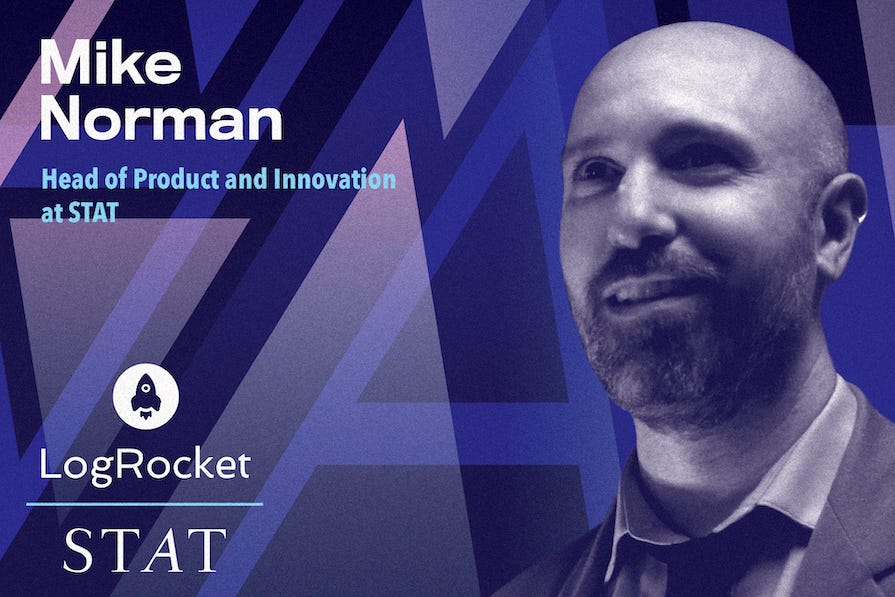
In our conversation, Mike discusses what it means to lead product at a media company where journalism — not software — is the core product. He shares how product and editorial teams collaborate in a fast-moving newsroom environment, and why trust and editorial integrity shape every product decision. Mike also talks about what it means to him to build products that exist in service of something bigger.
Product management in the media industry
Your current role at STAT is very different from anything you’ve done before. What do you find most rewarding about working at STAT?
I had never worked in media before. After 20-plus years in the digital industry, I didn’t know what to expect going into it. At STAT, the product is all our different channels. It’s the delivery mechanism for the content, as well as ensuring users can find what they want to consume and to keep coming back.It’s an engagement platform.
With that, the work the journalists are doing is incredible. They’ve literally been responsible for changing laws and saving people’s lives. Obviously, I’m not directly involved in any of that, but it’s incredible to work for an organization that has that kind of societal impact.
Coming from a digital agency where I was working on 40 to 50 projects a year, to now being focused on one thing lets me give a level of care to a product that doesn’t feel as transactional. At an agency, you do the job and move on to the next job. Here, you get to feel much more ownership and care over the product. It’s very different, and very enjoyable.
You mentioned your work at a digital agency, where you were building the product. At STAT, journalism is the product — and you have no say in it. What does it actually mean to be a product leader when the product that matters most isn’t yours?
It’s certainly interesting. In a digital agency, when you’re working on so many different projects, a lot of them aren’t the main product — they’re almost like lead gen or demand gen instead. In that sense, I had experience with that kind of thing. But once you move to a head of product role, there’s some expectation that you’re going to be focused on the main product. STAT was my first gig as a head of product, working on the specific product that we were selling.
From that perspective, it’s a little setting aside of the ego. It’s a different approach to how you speak about the product and what your focus is on. It’s more on the vehicle to get that product out to people — the journalism in this case. And there’s so much that goes into those products that really has to let the journalism shine.
Bridging product and editorial teams
How do you speak about the product?
It’s 100 percent on the editorial. We involve them as we’re talking about changes that will impact the delivery of their journalism. If we’re talking about changes to the website, especially article templates or how newsletters are going to be formatted, we consider them stakeholders in those projects. We certainly get their input when it comes to advertising because there are aspects about what we’re reporting on and what advertising can be that we need to consider. Especially as a health-focused publication, there are types of ads that we won’t run.
STAT is high-stakes, deeply reported journalism. How do you build for an editorial team in that newsroom environment that has to move fast and operate independently?
The editorial team has a lot of good ideas — mostly focused on how we can expand what we can do from journalism and storytelling perspectives. A lot of news is news, but a lot of it is investigative or storytelling as well. Supporting them and delivering that to the user is one aspect that they care about. How can we best tell our story? Those tend to be longer-tail projects.
But there’s also the practical side of it: “I need to accomplish a task in the CMS. I need to include this document. I need to add this widget. How do I do that?” As a small team, there’s only so much from a resource perspective you can be working on. A lot of times, those stories are time-sensitive, so it’s part of the job to drop what you’re working on and focus on those tasks so the editorial team can best tell that story.
Balancing different departments and media channels
The value proposition of STAT lives entirely in content you don’t control. What levers does product actually have to drive engagement and retention?
There are multiple channels. The website is the most obvious one, but we also have the app and newsletters, which fall under the product team as well. Each one works a little differently in trying to keep a user engaged, not just with the story they’re reading, but with the next story that’s going to grab their attention.
The journalism shines on its own. If we printed it in a newspaper or magazine, people would just keep turning the page. It’s a lot different in a digital environment where you have to encourage them to move on to the next story.
As great as it is for someone to read multiple stories in a single session, getting them to come back regularly is more important. If somebody reads 10 stories in one day, that’s not as impactful to us as them reading one story every day for 10 days. It’s really about making those channels work together to drive them back to the stories. The newsletters do a lot of heavy lifting. The app and its push notifications help build a habit around engagement that pushes people back to the website.
Especially now, we’ve seen a shift where we still get a lot of traffic from search, but we see a lot more traffic coming from something like Google Discover, which is a feed. You scroll, you click a story, you read it. A lot of times, people don’t even know what publication they’re reading. They just saw a headline and clicked it. There’s a good chance you’ll never see that user again. So how do you engage with that user in a way that informs them and gets them to potentially come back again or sign up for a newsletter?
How do you structure your roadmap when you’re balancing requests from different departments, like editorial, advertising, and the subscriber experience, all at once?
It’s a little bit political. You want to keep everybody fed. If you just focus on one team, everybody else starts feeling like they’re not going to get anything for a year. You have to make sure everybody is getting something to keep their teams moving forward, too.
But from a prioritization standpoint, we’re a business. We need to stay in business, so revenue-generating things are going to get a higher priority. That’s just reality. That doesn’t only mean ads. It includes things around gaining and retaining subscribers.
Anything that helps with revenue — whether that’s advertising, retention, or subscriber growth — is going to jump to the top of the queue. When you look at the media industry as a whole, it’s incredible how much negative change has been happening. You see layoffs constantly across publications. STAT has been healthy, but we have to ensure we stay healthy, and that involves revenue.
Leading lean teams as a product executive
You went from managing 40 engineers at an agency to leading a lean team at a 100-person company where most employees are on the editorial side. What does that shift ask of a product leader that most PMs underestimate?
First, a little bit of setting aside ego. On a small team, it means getting your hands dirty. As a head of product, you think about the high-level roadmap and making sure teams are working well together. But on a lean team, sometimes it means owning the feature yourself or stepping in when someone is out. When someone’s on vacation, I’ll say, “I’m going to own that for a week,” and that’s OK. There’s much more of an aspect of getting your hands dirty than I had when I was managing a 40-person team.
Honestly, it’s kind of fun. It’s easy to get detached from the work later in your career as you move further away from execution. There’s something rewarding about staying connected to it. At the same time, you have to balance that with higher-level responsibilities like roadmap management and budgeting. It becomes a mix of everything.
Do you have advice for product leaders who are skeptical about getting into the operational trenches like that?
Even on larger teams, it’s valuable to jump in every once in a while just to remind yourself what your direct reports are dealing with on a daily basis. As leaders, it’s easy to dictate how people should do their jobs and then create processes around them. Sometimes the most impactful thing you can do is actually immerse yourself in the work. I think it makes the processes you build more effective, and it helps you connect more deeply with your direct reports.
Ethical considerations in journalism
You have to think about ethics in a way most heads of product don’t. What are the ethical considerations when you’re working in the service of journalism, and what are the constraints?
First, it’s that you’re working in the service of journalism and trust is the number one thing. If readers don’t trust what they’re reading or how they’re consuming it, everything quickly goes out the window. It’s so easy to lose your reader base if you break their trust. That’s obviously a journalist’s guiding light, but as a product team supporting them, that has to be ours as well.
We have AI guidelines on our website that explain what we will and won’t do with AI. You see a lot of publications moving toward AI now and they’re running into issues with hallucinations around stories. You can only have so many mistakes before readers stop coming back. A lot of that drives how we do our jobs.
In terms of constraints, we’re very clear that we won’t rely on AI for content generation. We’re never going to use AI to write stories. Once we know the rules around what journalists are comfortable with, that helps us set our guidelines. Then it becomes our job to figure out where we can utilize AI tools or deliver tools that support journalists in doing their jobs more efficiently.
For example, it’s one thing to say, “Here are all of our stories.” It’s another thing to say, “We know your interests as a reader, so here are the stories we think will be most impactful to you.” Finding efficiencies that don’t break trust and still let journalism stand on its own is where our guidelines come in. That journalistic integrity aspect helps shape how we approach things.
Does it give you some freedom to have those very sharp guardrails?
It does. I mean, yes and no. I think when we’re having those conversations about, “All right, what are we comfortable doing?” and knowing exactly where the guardrails are is helpful. Whereas I feel like some organizations, or maybe even some journalists, are having thornier issues to the point of: “If we do this, will we be okay?” We never feel like we’re encroaching that far because we have those guardrails. So I do think it’s helpful. It makes us more comfortable with the decisions we make.
That’s not to say that we never run things by the editorial team like, “Hey, would we be comfortable trying something new like A, B, or C?” They might say, “We’re cool with C, but A and B, no, we’re not doing that.” I think we have a really good relationship with our editorial team. Realistically, any product team has to, and we meet with them regularly. Sometimes we’ll try to push them a little, but we’ll always defer to them. So we have a good sense as to where they’re comfortable, where they’re definitely not, and what that gray area is.
What’s the case for building a career as a ‘background player,’ a PM whose product exists in the service of something else?
No matter what you’re working on, you could tell a narrative in a way that can still make you a product hero. At the end of the day, you’re doing a job in service to a user. Whether you are building the actual product the user is using or providing the mechanism through which they consume the product, you’re still supporting both the company and the user.
That’s where the professional fulfillment comes from. I feel great about helping users consume our content because the content is really important. If we weren’t doing a good job, nobody would be getting that content. It’s incumbent on us to ensure users can access it, get value from it, and keep coming back.
What does LogRocket do?
LogRocket’s Galileo AI watches user sessions for you and surfaces the technical and usability issues holding back your web and mobile apps. Understand where your users are struggling by trying it for free at LogRocket.com.