

Marcos Kashima is Senior Director of Product, Mobile App at Lonely Planet, where he leads the digital transformation of a trusted global travel brand. With a foundation as an engineer and dual graduate degrees from Northwestern — an MBA from Kellogg and an MS in Design Innovation — his career spans 0→1 ventures, enterprise platforms, and growth-stage products across Brazil and the U.S. He previously served as Senior Director of Product, Data & AI/ML at Red Ventures, and earlier led the 0→1 development of Brazil’s first bill management and payment app.
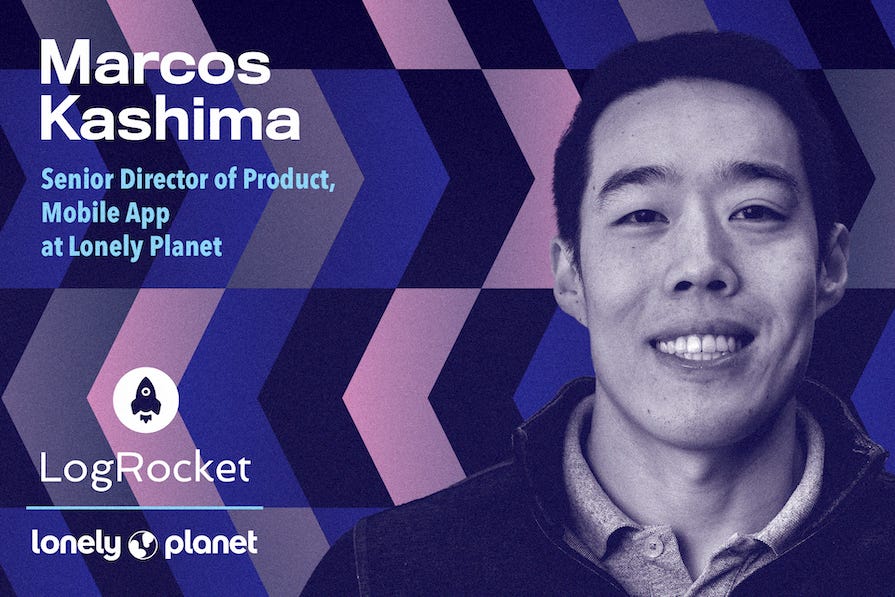
In this conversation, Marcos shares hard-won lessons in 0→1 product leadership. He makes the case for trusting intuition over data in early-stage work, explains why big bets generate stronger signals even when they fail, and walks through what it actually takes — in terms of team structure, PM qualities, and organizational sponsorship — to protect a new product inside a large company. Along the way, he tells the story of how a small, focused team unlocked a new category in the Brazilian fintech market.
The 0→1 mindset: Intuition, big bets, and diverse teams
When you think about what makes 0→1 product work genuinely different from growth or optimization work, what’s the most important mindset shift a product leader needs to make?
The main one is giving space to intuition over data. It’s not an easy one — data means confidence, and it’s really hard to trust your intuition. Some people can trust their intuitions easily, but not everyone. If you have a lot of experience, you need to trust in your intuition. And given that in 0→1 you don’t have enough data to optimize, you need this idea that I like to call big bets.
When I say big bets, I don’t mean building something unnecessarily big. I mean something that solves a meaningful problem and is differentiated enough. Big bets have two main benefits. One is that even if it fails and you don’t have much volume or data, because it’s a bigger change, it usually generates stronger signals. A small change in a product will not generate too much signal, but if you create a whole new big thing that’s going to solve this problem for the customer, you’re going to generate some signal even if it fails. But if it doesn’t fail, which is the best case scenario, you create more value. So, there’s only upside in thinking in terms of bigger bets when you don’t have much data.
How do you keep your teams from falling into analysis paralysis when you don’t have data to make confident product decisions?
There are two important things. One is customer empathy — really thinking about the customer beyond you as a customer, but others as a customer. And also having some sort of diversity. You have your intuition because you’re leading the team, but you also need to bring different perspectives and make sure that we are collectively trying to understand the customer.
Diversity is very simple — people are different, and you need to bring the tension. Tension is good. You bring that to offset the risks of being too biased. But at the end of the day, don’t rely too much on that. You’re never going to reach a situation in the room with so many diverse people where everyone is like, “Yes, we all agree on the problem. This is it.” Never going to happen. Then you need to make the decision based on intuition.
And then, there is a secret sauce, which I’ve seen a lot of times in bigger and more bureaucratic organizations like banks: execution. Ideation and execution have a symbiotic relationship. If the person who is ideating doesn’t trust the execution, they will try to be as perfect as possible. But if you can execute fast, you’re going to be less attached to your idea because you can learn fast and then have another idea. A lot of times, you need to trust your intuition and make sure the execution is good. Otherwise, you’ll try to be perfect and afraid to start executing.
Have you seen diversity help the decision-making process — and a lack of diversity lead to bad outcomes?
It’s very common for startups. You usually have an owner, and the owner brings people they know. They all think they think differently, but they kind of had the same experiences.
I see a lot of departmental diversity at Lonely Planet because Lonely Planet, by design, is diverse. It has people from all over the world. It’s very cross-functional and multidisciplinary because we are a publishing business that is trying to digitize. There are a lot of conversations where people bring a way of thinking that’s completely different. Whereas in the past I’ve seen, “Hey, we think we are being devil’s advocate, but actually we’re just kind of tweaking each other’s ideas a little bit.”
But there are challenges both ways. When you have a very diverse group, it’s impossible to reach a decision through a unanimous decision. The goal isn’t consensus; it’s collaboration. Every perspective that challenges your assumptions, even one you ultimately reject, stress-tests the intuition you’re going to act on. You leave the room having pressure-tested your thinking against people who genuinely see the world differently. That makes the call you’re about to make alone a sharper one. So the leader still decides – but they decide better.
Knowing when to shift from intuition to data
How do you know when it’s time to shift from intuition-led bets to data-led iteration?
Between intuition-led early stages and optimization stage, there’s a big gap. The transition between those two stages is where you continue to make big bets. Over time, you rely less and less on intuition and more and more on data as it becomes available. Your data informs the next big bet, meaning that we are not going to just change the color of a button or something on the landing page. You’re going to be asking, “Okay, what are the big problems I can solve?”
When to start the optimization stage is actually not a very easy answer. There are a lot of people in the market trying to understand how you measure product market fit. There are surveys you can use. The P&L starts to talk with you a little bit. But once you found it, that’s when you can start to optimize and drive more incremental revenue optimization decisions, like funnel optimization, increasing variety or referrals inside your app. And, usually, that’s the moment where people start to scale paid media and paid investments, which makes more sense because you want to make the most out of the money you’re investing.
Can you share an example of a time you started with a big, intuition-led bet?
When I was leading one of Brazil’s largest credit card marketplaces, we saw that Brazilians were increasingly motivated by credit card reward points. This idea of points is very normal for Americans, for Brazilians, it was just starting about 10 years ago. The big insight was that utility bills, one of the largest recurring expenses, remained a blind spot in terms of credit card usage. We saw an opportunity to unlock that category for financial institutions and help customers get more points from things they didn’t think they could get points from.
So, the goal was to start narrow and focus. Rather than building the full platform, we focused on the core problem: we want Brazilians to pay a bill with a credit card, and we want something very secure, robust. We focused 100% on the wallet functionality. It was a very simple, bare-bone mobile app. You had a wallet, you added one credit card, and then, do people want to connect their bills? Once we confirmed demand — we even secured a partnership with Visa — that started to increase the volume in our app a lot, and we decided to focus on other bottlenecks.
As more volume started to come, now data is telling us that a lot of people are having problems signing up, or they can’t find the app to download, or there was a problem with operations. Our nonexistent support operations was a bottleneck, so we decided to build a support team. All of that started to become true because we validated the demand. And then it started to become more incremental features, until it became more of an optimization stage.
Why a bill management and payment tool in a credit card marketplace? At the end of the day, we were trying to collect behavior data for the users to offer better credit cards — helping customers understand what credit card they can be approved for, given their utilities, which is basically a very good proxy for, “What is our financial condition?”
Building the right team for 0→1
There’s a common instinct in larger organizations to staff up when launching something new. How do you structure a team in a 0→1 effort?
For me, it’s very simple: keep the team small, nimble, isolated, with clear autonomy. Big orgs often think that if you hire more people, it’s faster, but it adds a lot of problems — communication, overhead, scope creep. Adding more people can end up delaying launch. As we talked about, yes, you want to use your intuition, but your goal is really to get data, the volume. If you keep postponing launch, you’re never going to get insight on what actually worked and didn’t work.
And there’s another problem that happens over time — the more people there are, the more the scope shifts. You hire smart people who want to make smart decisions, and they’re not always going to agree with you. If you have a very clear view as a leader, sometimes you need people who can make that reality in a small team.
Are there specific qualities that make a PM better suited for 0→1 work? And are there warning signs that someone who excels in a scaled environment might struggle in an early-stage context?
In addition to intuition, which you develop over years of diverse experience, and which is usually what I look for in 0→1 PMs, it’s important to be very execution-driven. Not project management execution, but a little bit of technical intuition — speaking the same language of engineering, being able to collaborate. Because a good solution is not a product top-down solution that design and engineering executes. It is a solution where you come with a POV, and then with engineering, you develop a better solution that is simpler, faster, and reaches the same goal.
I usually find those skills better in PMs who have a little bit of experience in both worlds — who understand what it means to come from an engineering background. And you want someone who has a lot of startup experience, because in a small team, you need to collaborate very closely. In a lot of bigger corps, teams are more siloed and process-driven.
On the flip side, the warning sign is someone who has only big names in their resume. They’re used to a lot of process, a lot of formality, and a lot of data. Not always, but usually. If you worked at Google, you’re used to launching something and getting enough data in two days to make some decisions. By design, you’re also used to slower execution, because of very complex technology.
Protecting innovation inside large organizations
You’ve experienced 0→1 both inside large organizations and in new ventures from scratch. What surprised you most comparing the two?
At Red Ventures, I helped open the Brazil office. Our main business model is partnerships with big organizations, including the largest bank in Latin America, where we help them build technology to reach a specific business goal. Performance-driven, not output-driven. Red Ventures also had, in Brazil, a venture builder where we used the cash-cow money to reinvest into new digital products or digital brands from scratch.
The biggest surprise was realizing that what kills innovation and speed is the system, not the people. Some people think startups are successful because they have very passionate and committed people. The reality is that there are a lot of special and committed people in big organizations everywhere, but the system — processes, beliefs, culture — creates resistance that, over time, slows down and demotivates those agents of change. I partnered with a lot of big orgs. There were pretty good people there who were so happy to see us because we were helping them overcome a resistance of the system that they couldn’t by themselves.
When you’re doing 0→1 inside a large organization, there are a lot of forces working against you — competing priorities, risk aversion, stakeholders who want to see the product grow before it’s ready. How do you protect an early-stage product from getting derailed?
It’s really important to have a sponsor — a senior leader, or anyone who is very influential — who can protect the team. A 0→1 product has different success metrics, a different review cadence, and a different tolerance for failure. If there’s no leader who understands that, it’s hard to convince everyone that the team is being successful. There’s a lot of noise in the organization — the sales team wants to use that feature, the data team wants to change the platform. And everything feels urgent because the rest of the org is making money, whereas that team is not.
The sponsor helps shield those teams from the inevitable structural incentives of a big organization.
And there is one more thing: the definition of progress. In a big org, progress means money — P&L, revenue, or deliveries — we delivered this feature, this expansion internationally. But in 0→1, progress is not that. Progress is feeling confident that the direction you’re going is right, or, even better, feeling confident that the direction you’re going is not wrong, meaning you’re going to fail a lot. If you don’t have a leader who understands that, they’ll keep incentivizing the team to produce results as soon as possible.
The biggest mistakes and what to avoid
Looking back across all your 0→1 experiences, what’s the biggest mistake you’ve seen product teams make?
Adding complexity. I’ll frame complexity in a very broad term. Adding complexity can mean adding more features that are not necessary. Every new thing you develop is more complex to develop. And it adds data noise. The more things there are for the customer to interact with, the less customers interact with each thing, so it’s really hard to know what matters.
Adding complexity can be adding more people, more ideas, more communication overhead, more scope. And adding complexity also means adding more process. Too-rigid ways of thinking usually prevent adaptation. “Oh, we need to do the two-week sprint perfectly, no change of scope.” When you are very early, you need to have a little bit of room — maybe it’s a one-week sprint, and let’s change scope if we think it makes sense. The smaller you are, the less process you need. You want to focus 100% of your time on one big thing you’re trying to solve for the customer and understand if that’s the thing that really matters. And if it doesn’t matter, let’s go to the next thing.
For product leaders operating inside companies that want to build 0→1 capability, what structural or cultural conditions have to be in place before it can actually work?
It links back to the incentive structure. You need a leader who defines what success looks like and can separate the team from the organizational noise.
The other thing is real autonomy, which can come in different levels. I’m not saying, “Hey, this team can decide whatever they want about this product.” No. It’s the job of the leader, or sponsor, to really decide the level of autonomy. Maybe it’s, “The team needs to build this thing. How they’re going to build it, and what they’re going to do is their job to explore.” Or, “We already have a design well-defined — we just need to execute.”
But make it clearly defined and give autonomy in that space. Because a team that needs to get a sign-off on every small decision will have less and less confidence. And the less decision-making they can do on the spot, the slower you’re going to go.
What does LogRocket do?
LogRocket’s Galileo AI watches user sessions for you and surfaces the technical and usability issues holding back your web and mobile apps. Understand where your users are struggling by trying it for free at LogRocket.com.