

Kim Ross Jackson is Director of Ecommerce at Harley-Davidson Motor Company. Her experience spans founder-led companies and global brands, including leadership roles at PUMA, Talbots, J.Jill, ALEX AND ANI, Clarks, and The May Company. A frequent guest speaker at industry conferences and lecturer at the university level, Kim is known for creating clarity in complexity, standing up new concepts, and helping organizations evolve how they think about product, customer engagement, and long-term growth.
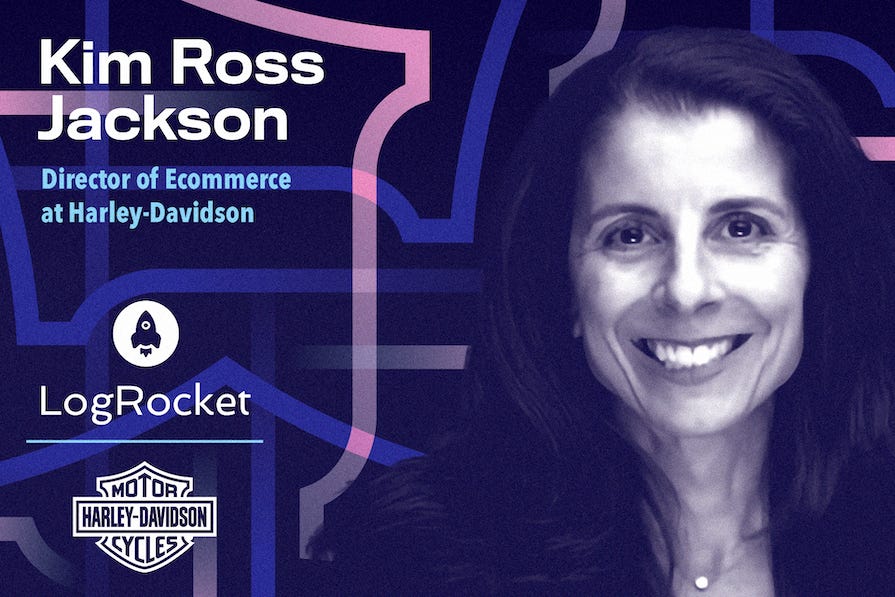
In our conversation, Kim talks about what it takes to build people-first ecommerce teams in an increasingly data-driven and AI-enabled world. She discusses why context, human judgment, and cross-functional collaboration still matter just as much as analytics and automation, as well as how her early merchandising experiences shaped her leadership philosophy.
Balancing data with human judgement
You started your career in retail merchandising long before modern analytical tools existed — decisions were made by instinct and observation. How did that environment shape the way that you think about judgment, accountability, and decision-making today?
What’s interesting is — and I’m going to age myself here — that I remember the first time a company handed me a laptop and said, “You need to share this with your assistant.” There wasn’t any data flying around. We all used the same reports in the form of big, thick paper piles, and every Monday, we’d drag them into face-to-face meetings with management.
We were all looking at the same data. We weren’t making different dashboards or pulling from diverse sources. These were the reports, and you needed to just understand how to read them, review your numbers, and use intuition to make decisions.
Beyond that, we were out talking to people face-to-face. It was pre-Internet. That’s how I got into this field in the first place. When I was a little girl, my mother hated shopping, but I’d ask to go to the mall so we could people-watch. I don’t know why — I just thought it was exciting. I’d go into stores, talk to associates, watch customers shop, and interact with them. I was gaining something that reports wouldn’t give you — a deep understanding of customers. That’s where you realize there’s a lot of context that can be missed.
I remember when I was at Talbots, and the unfortunate events of 9/11 happened. Our numbers were down, nobody was buying, but the stores were full. Women were coming in to connect with the associates. They just wanted to talk — there was no pressure to buy. If you looked at the metrics today, you’d say, “There’s traffic — why aren’t they converting? The merchandise must be awful.” But you wouldn’t know the human side of what was really happening unless you were there — unless you had context.
What gets lost when organizations over-rotate on data and drift away from the human judgment behind it? Can you share an example of a time where the data pointed in one direction, but your instinct led you to make a different call?
It’s that context — that human piece. And you can miss opportunities you never would have thought of. When I was at The May Company, we were all given the same reports across divisions. You could compare performance and contact peers to understand differences. I was then buying special occasion dresses, and the whole company was doing well with beaded dresses — except me. It was a sore point. I bought into what the data said was working, but I couldn’t sell it.
Then I looked around, and I noticed my floor was filled with younger women — there were lots of colleges nearby. These women were going to formals and socials, and we were doing well with non-beaded dresses — cocktail dresses, little black dresses, that sort of thing. As a merchandiser, you can only bring in so many black dresses, so I added color.
The colorful dresses started selling faster. I talked to my managers and learned that people were buying them for their bridesmaids — typically eight at a time. Instead of going to a bridal store, they were buying from us. So, from that, we built a bridesmaid special-order business. That opportunity wouldn’t have happened if we had just followed the data. We had to dig deeper into what was actually happening in our market rather than blindly following the data.
Making decisions in cross-functional environments
Building a successful ecommerce business requires getting people with different priorities to move together toward a common vision. How do you create alignment across functions when everyone is optimizing for something different?
That unifying aspect is so hard. You think it’s going to be easy and that everyone’s going to align, but when you’re working on an ecommerce platform, so many things can go awry in a given day. It’s all interconnected, with systems and data feeding other systems. You might go to tech and say, “We want to add this vendor,” or “Customers are calling — is something broken?” But there’s only so much bandwidth and budget, so you have to decide which decisions or paths forward create the greatest value for the company and the customer.
Sometimes things get prioritized because they fit into work already in progress. It’s a jigsaw puzzle. Tech isn’t serving just one group — they’re a shared service. So, teams come together, talk it out, and make decisions for the greater good of the customer and of the business.
As AI becomes more embedded into how teams operate, from analysis to planning, where will human judgment and leadership still matter most?
AI does amazing things. I use it all the time — business, personal, “how do I fix this?” It gets work done in minutes that used to take days. But with that, it can’t navigate an organization. It doesn’t understand context. It can’t understand how people work together or how data is being interpreted across teams.
For example, I recently asked customer service for tracking call data. I looked at the data and started drawing conclusions, but after reviewing it, I realized it wasn’t a full year-over-year comparison. I was about to make a business decision based on incomplete data. I had to go back to the analyst and ask follow-up questions to understand what I was actually looking at. The point is that you always need context. You need to connect different inputs from different sources and experts to move the business forward. Otherwise, how do you work as a unified enterprise?
Servant leadership in practice
Aside from your professional accomplishments, you also have a Master’s degree in organizational leadership and a coaching concentration. What does servant leadership mean to you in this context?
When I first learned the term “servant leadership,” I felt validated. It was how I’ve always led. It’s always about your people, and I am very supportive of them because I truly care.
To me, servant leadership is removing roadblocks so people can operate at their best, both professionally and personally. How you approach your work bleeds into aspects of your personal life. We want employees who are happy and engaged. We spend more time with these people than we do with our own family. You want to be able to laugh together, celebrate each other’s wins, and support each other when times are tough.
For me, servant leadership is the easiest way to get people to feel empowered. I think it’s deeply important that people feel heard, are invested in their work, and feel good about what they do every day. And much of the time, that means getting out of the way. Some people won’t raise their hand or set boundaries. As a leader, it’s your responsibility to check in and make sure they’re not overwhelmed. Teams are getting smaller, work isn’t going away, and even with AI, someone has to validate the output.
So it’s about regular check-ins and stepping in when needed. If I can make a five-minute call that removes pressure for someone, I’ll do it. That’s serving your team.
You talk a lot about leaning into people’s strengths. Most leaders talk about developing people by closing gaps, but you approach it from the opposite direction. What does it look like to build a team’s strategy around what energizes people rather than what they’re missing?
I’m very big on using people’s strengths. I’m certified in the Strengths Profile methodology, which is an assessment tool that breaks down your strengths into three different categories: some things you’re naturally good at and energize you; other things you’re good at but drain your energy; and skills you haven’t tried yet but might love.
And then there are weaknesses. If writing is a weakness, like it is for me, make peace with it and find someone who’s great at it. I have a friend who’s a beautiful writer. When I need a bio for a professional publication, I ask her to take a cut at it for me. Even within friendships, that’s your team who can help the cause.
Teams work the same way. One person is great at product selection, another at analytics, another at vendor negotiation. They all work together to fill gaps.
Can you share an example from your background of a time when the culture either made or broke the conditions for a people-first leadership style to actually work?
I have a hard time in environments where autonomy is not nourished. A culture where I struggle is one where I lose a sense of decision rights and empowerment. I am fortunate to work for a leader and a company who value my independent perspective and approach to my work.
Flexibility and autonomy are really important, but people also need to own their decisions that exist within a greater framework. I had a boss who was a great mentor to me, and we’d sometimes disagree. However, we’d eventually align on a decision, and both stay invested in the agreed-upon outcome. We’d review the results together and learn from them. We were able to grow and bond with our shared outcome, and that’s what’s important to me in a work culture.
As organizations become increasingly data-driven and AI-enabled, what do you think will distinguish truly great ecommerce and product leaders from the rest?
It comes down to being nimble and being flexible. None of us knows what’s coming around the corner — whether it’s AI, a new business direction, or a situation in our personal lives. Teams need to be able to adapt. Everyone should be brought along so they can step in when needed. That happens through constant communication. We don’t work in silos. It’s about working well together so we can support each other in the best way possible.
What does LogRocket do?
LogRocket’s Galileo AI watches user sessions for you and surfaces the technical and usability issues holding back your web and mobile apps. Understand where your users are struggling by trying it for free at LogRocket.com.