

Jessica Sapsis is Senior Director of Product at Toast, a point of sale and management system for restaurants, hotels and retailers. She began her career in product management at BzzAgent, an engagement platform for consumer brands, before becoming a digital producer in biotech. From there, Jessica joined Staples as an ecommerce product manager and later moved to CVS Health working in their consumer Innovation Lab. Since then, she has served in various product management leadership roles at Toast and is also a featured speaker at Product School.
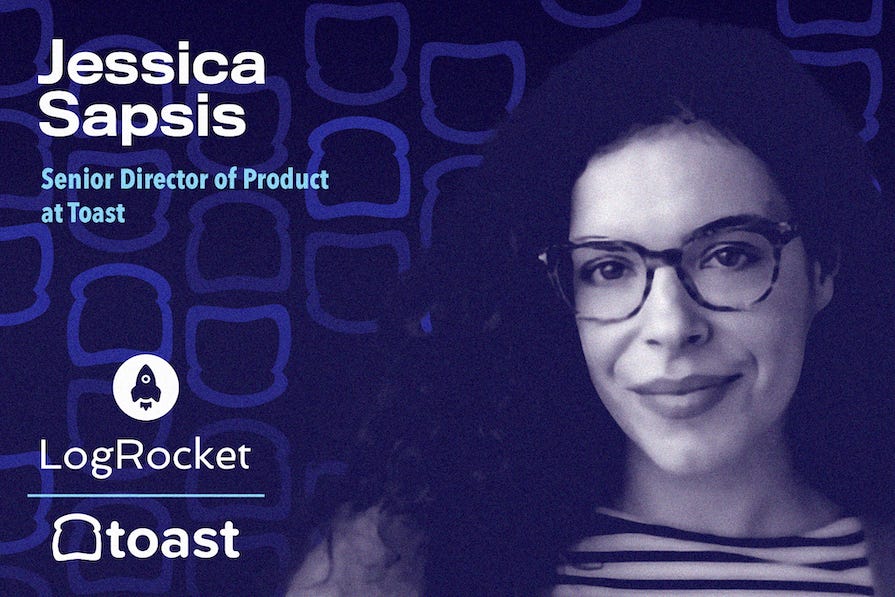
In our conversation, Jessica talks about her team’s efforts to create and refine products for Toast’s enterprise customers, while also creating value for the entire Toast customer base. She discusses the challenges of working on products for enterprises, such as complex integrations and other unique customer needs, as well as how they structure feedback loops across personas.
Building for enterprise customers
A lot of product leaders talk about their work as being a mini CEO. That model can be challenging if your team has different goals from adjacent teams. In that scenario, how do you work to align your team’s goals?
One thing that’s great about Toast is that we are all aligned on common core principles and priorities. This really helps when there are so many different product and R&D teams working in so many different areas of the product.
Toast’s core business is focused on small, dynamic customers and operators, but I look after the Toast Enterprise business — a customer sector that has unique needs. Enterprise customers have different expectations of how they interact with their technology partners. They frequently have more complicated tech stacks and have different implementation, rollout and ongoing account management needs.
When the Enterprise R&D teams think about our work we rely on and closely align with our company’s core principles. One of them is being “customer obsessed” — and for us that means making sure that the work that we’re prioritizing is well aligned with customer value. This is a type of core principle that translates across all our segments and serves us well when working with other product teams across Toast.
For example, we may need to invest in a feature or capability that is initiated for a larger, more enterprise level brand, but would still have a meaningful positive impact for a smaller operator who owns one or two restaurants. We’re always looking for opportunities to democratize our work and ensure we are delivering on the customer value of the platform as a whole. A good example of this is some of our recent investments in Toast’s Kitchen Display Screens. Enterprise R&D was able to work closely with our Kitchen Operations R&D team to deliver enhancements that make it easier and more efficient for customers to prepare orders in an “assembly line” fashion. This was a feature highly requested by enterprise customers, especially those in quick service environments, but it’s one that makes food prep more streamlined for customers of all sizes. If you have a make line set up like a factory line floor, this feature makes your life easier, no matter the size of your overall operation.
Toast R&D has a common mission to support restaurants, retailers, and hospitality operators. These different end users all share common problems, so my teams focus on that common denominator across the board and that unlocks a clear path for collaboration that all our partners in R&D (and other cross-functional stakeholders) can get behind.
Do you find you’re frequently competing for resources with teams that focus on SMBs rather than enterprise customers?
This is a reality in the product space as a whole — there’s always a limited amount of resources. We have to be fiscally responsible, efficient, and honest, this keeps your prioritization and creative approach muscles strong. So in some ways I appreciate this dynamic as a reality of managing an R&D team.
Enterprise does have dedicated teams, roadmaps and priorities however, and they don’t always perfectly align with other parts of the business. Something we’ve gotten very good at is working cross-functionally with partners in other parts of the organization to ensure we have the trust, clarity, and alignment on approach to ensure a great working relationship. We want to make sure that our colleagues feel comfortable letting us work in their spaces and feel heard every step of the way. To do this at scale we need a really solid development process, repeatable patterns, and a high bar for quality, communication, and engagement. Without this, we’d get bogged down by issues, overly burdensome oversight or other friction points that just slow down the timeline by which we can deliver value to our customers. The more we can hold ourselves accountable and our work to a high standard, the more trust we have in the organization, the faster we can go.
Even though the core problems faced by operators at the store level are the same across the board, we often need to level up the scalability of a solution for our segment. We have dedicated resourcing that we protect and shepherd to move those initiatives forward. In other places, however, we’ll partner and advocate within the organization. We’ll tell other teams, “Hey, we have this problem. Our customers are trying to achieve this goal. How does this map to what you’re trying to do in your roadmap?”
Often, we find a common thread between what an existing team is working on and what our team is pursuing for enterprise needs. In those cases, we’ll double down and ask, “How can we get there faster together?” This helps us solve a problem for both independent and enterprise operators just by having a conversation about use cases and approaches to make sure we cover all the bases.
Teams are sometimes surprised by the level of overlap that exists between customers of different sizes. Restaurant operators have a lot of the same core problems, enterprise is just magnified.
Feedback and navigating customers’ complex ecosystems
There are some unique challenges when your ICP is not just the enterprise customer, but a subset of that, such as the enterprise customer’s internal IT team. Could you say more about that?
Sure. One of the unique things about working with an enterprise customer base is the depth of their operations. An independent restaurant or retailer, they typically work from a small team — an owner/operator, maybe one or two additional employees who support them. They’re a one-stop shop where this small group manages their POS, inventory, procurement, payroll, and more. They also handle operations, including any integrations with key partners and third parties who provide services like ecommerce or delivery.
But enterprise customers will often have specialized functions. A marketing team, pricing team, analytics team, POS administration team and more. From a product development perspective, it’s been amazing to really get a sense of how they work, benefit from their specialized knowledge and translate that into seamless, delightful product solutions. There is a clear benefit in closely working with enterprise customers: engaging in the discovery process, taking them through wireframes/designs/prototypes, etc. Showcasing what Toast can do for them that’s different and better than their previous solutions is one of my favorite parts of this job.
What are some of the ways you work with these teams within your enterprise customers to influence the roadmap?
They’re great partners and collaborators. Toast has a very vocal, engaged and insightful Enterprise Customer Advisory Board that we work with regularly. We talk about feature ideas, market innovation, their strategic priorities, and the specifics of their teams using Toast day in and day out. I love that part of the job. They bring to the table a perspective on their own tech priorities outside of Toast, and that can be really insightful for us also.
They have high expectations, which we’re always striving to meet. They want flexibility, configuration support, and to tailor the solution to exactly what their teams need to be successful.
How do you structure feedback loops to ensure you’re addressing immediate customer needs while also anticipating future requirements?
We build strong feedback loops with the teams engaged in the work from the beginning. In addition to the Customer Advisory Board, we also work closely with our Customer Success, Care, Enterprise Solutions and Onboarding teams. They’re huge stakeholders for us. They are frontline colleagues who always offer a good pulse on how things are going.
We consider what our customers are looking for now and in the future. Where are they going strategically? What are they looking at for the next six months, one year, or five years? How do those needs align with Toast’s long-term strategy? How we are thinking about our investments and product bets? To truly understand and meet both current and future needs of our customers, our team really prioritizes a triad of inputs — internal stakeholder awareness, long-term strategic vision, and customer relationships and empathy. By triangulating across those, we aim to find the best path forward that offers the right balance of “just needs to work” and innovative solutions for the next generation of restaurant tech operators.
Lastly, we go onsite for real-time feedback. One of the important parts of working within an enterprise organization is that the POS is the hub that plays nicely with the rest of the tech stack. For example, we have a team working on a significant integration update, so we sent members of our product, design and engineering teams onsite to watch real-world operations, engage in full-day workshops with both the customer and their other vendors, so we could
develop a unified approach. We never want to develop in isolation — we think holistically about the problem end-to-end and in the enterprise space, this includes consideration of customers’ other vendors and partners and the real world tangible experience of the restaurant operation itself.
Investing in work that impacts all customers
Traditionally, enterprise customers have more specific needs compared to SMB, but as you highlighted, you’re still inherently solving the same problem. Given those specific needs, though, do you create and roll out unique features for specific customers?
We can, but we find that everyone wins when we can invest in the platform to meet their needs more broadly. This sets us up to improve the product for all Toast customers and support other enterprise customers down the road. If a particular feature isn’t super applicable to the single-unit customer, but it is something we think a lot of our larger customers are going to benefit from, we invest accordingly.
You’ve talked a fair amount about your team from the standpoint of communication and alignment. When you’re hiring for your team, what specific qualities do you look for beyond education and professional experience?
When you work for enterprise customers, there is a certain level of process orientation that’s helpful. Communication skills are really important as well, especially when sharing a long-term vision. You have to bring people along the long-term journey while also supporting a near-term value proposition that creates excitement. I’m always looking for that in terms of how a candidate communicates their work.
To get a sense for this, I like to ask situational questions, like, “What is the hardest problem that you’ve had to solve?” “What types of problems do you like to solve? Tell me how you broke it down and what shipped first?” There’s a lot of platform investments required to build robust, strong enterprise products, make those investments, and tell that story about why it’s important is perhaps the most crucial aspect of the job.
I’ve also asked people when they’ve had to say no to someone. You have to be able to say no. That’s really hard, especially when you are so close to customers and have a lot of pressure within the organization. It’s a super important skill to not only be able to say no, but also bring people along with you and communicate effectively why you’re saying no. Sometimes the inverse way of asking about this is “Tell me how you explained why you couldn’t do something and what were the reasons and the trade-offs involved.”
In the enterprise product world, a lot of the problems that we are working on are complicated and full of dependencies. We have to make sure that we’re tackling and resolving dependencies quickly and upfront so the team isn’t blocked later on. I try to assess whether a candidate has the baseline program management skills to keep everyone on the rails and aligned.
Lastly, I always look for a sense of ownership — the ability to take responsibility for the final outcome of this work, break down these items, and tackle the many different functions required to get there. Having a strong sense of ownership, accountability, and incremental delivery are probably the most important aspects of the role.
What does LogRocket do?
LogRocket’s Galileo AI watches user sessions for you and surfaces the technical and usability issues holding back your web and mobile apps. Understand where your users are struggling by trying it for free at LogRocket.com.