

Jesper Grode is Senior Director of Product Innovation at Stibo Systems, where he drives strategy at the intersection of AI-powered master data management, sustainability, and emerging technologies. With a Ph.D. in Computer Science from the Technical University of Denmark and more than 20 years in data management, Jesper has held roles spanning R&D, consulting, product strategy, and academia. His career has combined hands-on technical expertise with leadership in shaping data solutions for global enterprises.
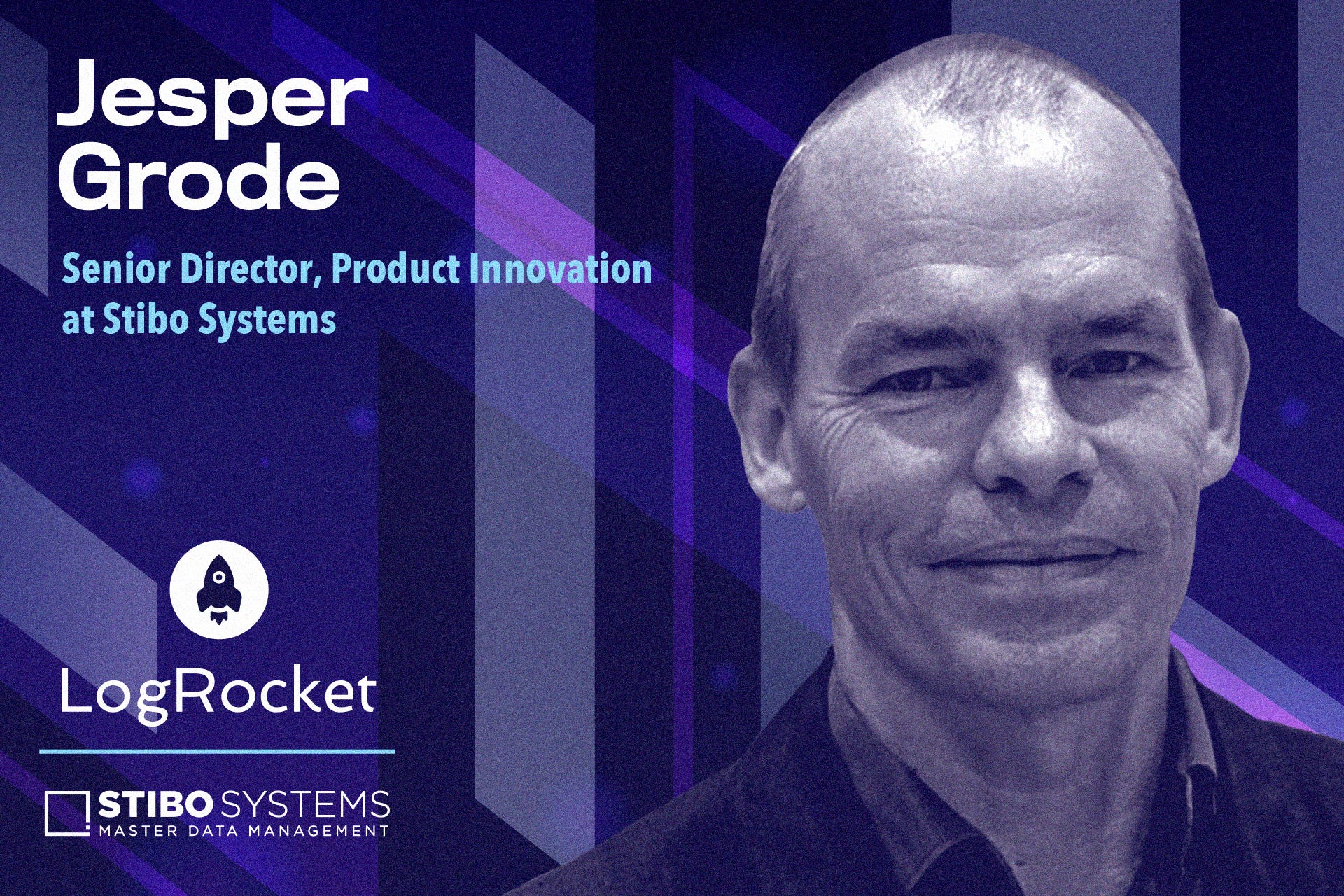
In this conversation, Jesper shares how decades of institutional knowledge shape his approach to innovation, what companies often misunderstand about innovation versus invention, and how his academic background influences the way he leads and mentors teams. He also discusses the balance between long-term, horizon-three innovation and near-term feasibility, the role of AI in both product development and customer solutions, and why human involvement remains essential in the innovation process.
Drawing on decades of perspective
How does your diverse career experience at Stibo Systems inform how you approach product today?
It helps me see problems from many different angles, not just the customer’s. Customers have problems, and we need to find solutions. But having done my tour of duty in R&D, support, partner management, alliances, R&D again, and now innovation, I know we need to make sure whatever we do is feasible, viable, valuable, and achievable. It doesn’t help if it’s just a great idea but not feasible, or if colleagues in support will struggle, or sales and marketing can’t sell it. So it’s about combining market knowledge, technical knowledge, and deployment realities. These shouldn’t hinder free innovation, but they serve as anchor points for reflections among my team.
How do you balance the freedom to innovate with alignment to the CPO’s strategic vision?
It can be difficult. Innovation comes at a cost and may not be profitable from the start. At Stibo Systems we’re foundation-owned, so innovation has more room here than at many companies. We have a sustainable business, and much of our earnings are reinvested into innovation and growth. That’s a great setting for innovation, but it doesn’t mean we should go off and do things that are too far out or too risky. Whatever we do still needs to make sense in a business setting. Innovation must be bold, but it also has to be grounded.
How has institutional knowledge helped you navigate changes over the years?
I’ve been with Stibo Systems since 1998, back when it was called Stibo Datagraphics. Change has always been part of the journey — if we hadn’t changed, we’d be out of business. One thing my peers and I have focused on is ensuring there’s a common goal: keeping customers happy while sustaining our business. That common goal drives passion, and with passion many things happen naturally. Even when we went through rough times, people stayed motivated because they understood the bigger purpose. And in cases where my team hit impediments, I always had someone to call. Relationships and common goals make a huge difference. You can grow passion if you make sure people see how their work ladders up to that purpose.
Innovation vs. invention
What do people misunderstand about what it actually takes to innovate?
People often confuse innovation with invention. Invention is creating something entirely new — the wheel, fire, vaccines — often by accident. Innovation is different. It’s about combining existing technologies and knowledge to solve problems. Generative AI is a good example. It’s mathematics that’s been around for centuries, machine learning for decades, just scaled up enormously. But it’s still existing technology combined in a new way. That’s innovation.
I truly believe there’s a big difference. Invention often happens by accident. For example, there’s a medication that makes people not want to drink alcohol. I think it was originally tested for stomach infections, but the effect on alcohol consumption was discovered by chance. That’s invention. Innovation, on the other hand, is deliberate and structured. It requires connecting dots across different domains and disciplines. It’s about seeing the potential of existing components and reimagining how they can be used. That process is systematic, not serendipitous.
Even in zero-to-one product building, is it still usually innovation, not invention?
Exactly. You’re rarely inventing something net-new. You’re usually combining things in a new way to solve a problem better.
Lessons from academia
You also spent time as a professor. What pushed you in that direction?
After 13 years at Stibo Systems, I thought, okay, I’m in my mid-40s — if I’m ever going to try something different, now’s the time. I didn’t want to just move to another software company; that would feel too similar. So I went into academia to work with students and teach what I’d learned. What made me successful there was having real-world experience. Students often said it was great to hear how the concepts they learned could actually be applied in real life. For example, I could explain how a database was used in a real piece of software, which made the subject come alive for them. It wasn’t just theory — I could show them how it worked in practice.
When you returned to the private sector, did lessons from academia carry over?
Absolutely. I never regretted leaving for four years because I brought useful insights back. When I rejoined Stibo Systems in 2015, we were building the Stibo Systems Academy to train customers in using our software. My university experience with Bloom’s Taxonomy, learning principles, and styles helped shape that program. Even today, when I onboard new talent, I think about their learning style. Are they visual? Textual? Do I need to sketch on a whiteboard or send research documents? That academic perspective is still valuable.
It also changed how I lead teams. I pay more attention to how people absorb information and where they need support. I try to create an environment where learning is continuous, not something that ends with onboarding. That mindset came directly from my time in academia.
Grounding innovation in feasibility
How does alignment with R&D help keep far-ahead innovation realistic?
It comes back to feasibility. If we start an innovation project where our platform can’t support it, it won’t fly. A great idea isn’t enough if it’s not feasible in our current setting. For innovation, the key KPI is the path to revenue. The sooner you can bring it to market, the sooner you create cash flow. That’s not always immediate, but we can use leading and lagging indicators. For example, if I post about a prototype internally and hear nothing, it’s probably a sign we’re headed in the wrong direction.
How are you defining horizon three in your work?
Horizons one, two, and three describe near, midterm, and long-term priorities. To me, horizon three means solving problems in completely new ways — more scalable, efficient, or cheaper. It’s about tackling the unknown. We’re still learning as a business how to do that, but it’s about combining existing knowledge and technology into new solutions. Horizon three is the space where you don’t have all the answers.
Is it hard for your team to stay motivated on current work while also thinking so far ahead?
It can be. Engineers, data scientists, and product specialists want to see outcomes — to hear, “Great solution, I can sell that tomorrow,” and see it in the market. That happens sometimes. But we also define “done” for innovation projects in ways beyond market launch. It might be writing a Technology Insights report that investigates a technology’s relevance. If it’s useful, great. If it’s not, that’s also a result — now we have a point of view. We can say, for example, “blockchain for master data management is probably not a good idea.” We may not know the use case, but we understand the technology and can explain why it doesn’t fit. That definition of done helps motivation and satisfaction.
We also celebrate small wins along the way. Even if something doesn’t end up as a product, the learning itself is a success. Recognizing progress keeps people engaged.
The role of AI in innovation
How do you connect current user experience to far-out innovations that can’t yet be tested directly?
Fortunately, our technology is easy to connect to backends like AI/ML engines. That means we can quickly prototype and test internally or with clients through co-innovation projects. Where that’s not possible, we use wireframing, rapid prototyping, or even AI-assisted coding to get results faster. Sometimes we run vibe coding experiments, where engineers test code generation tools to quickly spin up prototypes. Even if the code isn’t production-ready, it helps us validate concepts.
How do you see AI tools changing your work?
It’ll be interesting to watch. Some of my engineers have tried AI coding tools. Their experience is that it’s not a waste of time, but it doesn’t produce results as good as what they could do with a co-pilot. At Stibo Systems, AI is not just a trend — it’s a strategic pillar shaping how we operate and innovate. Our approach is anchored in becoming hybrid intelligent, meaning AI is embedded across products, processes, and ways of working. To achieve this, the Stibo Software Group, to which we belong, has established an AI Center of Excellence (CoE) that drives enablement, governance, and experimentation across the entire organization. It will help us focus on adoption by helping people across the organization build confidence and competence in using AI tools, fostering a culture of learning and responsible use so AI becomes a natural part of everyday work.
Do user-facing AI features and internal AI development inform one another?
They’re different, but both are important. Internally, for example, I recently created a job description for a new Industrial Master’s Student role. I used a co-pilot to draft and edit it, which saved me time. That’s operationalizing AI internally. On the product side, embedding AI in solutions is essential. Customers expect it. These two sides don’t directly inform each other, but they’re connected in the sense that both are necessary to stay competitive.
Do you think innovation will always require human involvement? Can’t generative AI just create what’s next?
I believe human interaction is still necessary. Hybrid intelligence — combining AI with humans — is critical for innovation. Machine learning and LLMs are statistical models. If they only train on outputs from each other, they’ll degrade. You need human thinking, empathy, and understanding to build the right solutions. AI will accelerate things, but it won’t replace human insight.
What does LogRocket do?
LogRocket’s Galileo AI watches user sessions for you and surfaces the technical and usability issues holding back your web and mobile apps. Understand where your users are struggling by trying it for free at LogRocket.com.