

Jennifer Schwartz is VP of Digital Product at Universal Audio, where she leads digital product strategy for the pro audio brand. Before that, she spent over six years as VP of Digital Product at Fender Musical Instruments Corporation, where she built the company’s entire consumer-facing digital ecosystem from the ground up — including Fender Play, a subscription learning platform with more than 2,000 video lessons, and Fender Tune, Fender’s first-ever mobile app. She has also held digital product and content leadership roles at The Beachbody Company, Live Nation Entertainment, and Walt Disney Internet Group, working across music, entertainment, and health and fitness.
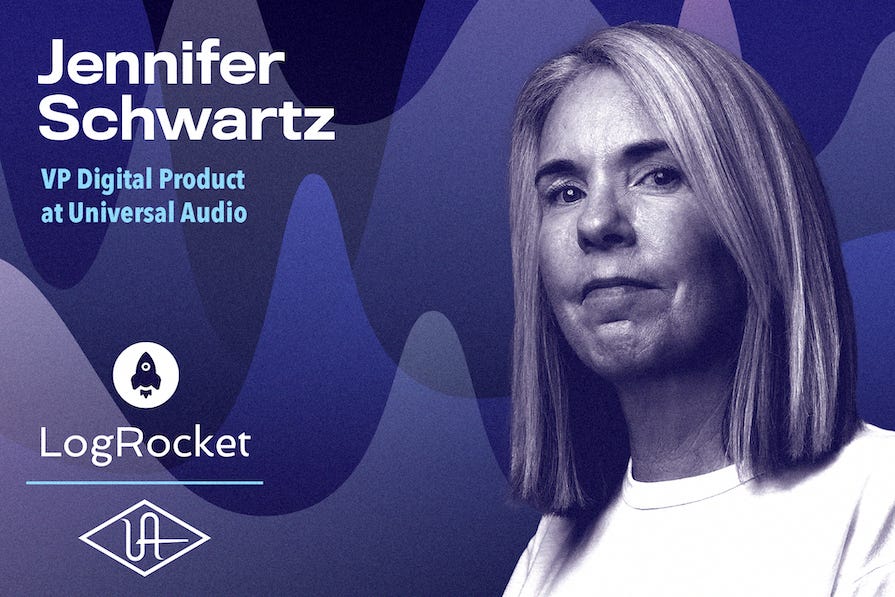
In this conversation, Schwartz talks about what inclusivity actually means for a product team — not a single interface that tries to serve everyone the same way, but a product that lets a first-time player and a 25-year veteran each find their own moment of joy. She discusses building teams that include both the expert and the beginner in the room, translating jargon like reverb and distortion into something a new player can feel rather than just read, and why she pitches inclusivity to leadership not as a values statement, but as a growth number.
Redefining who counts as a musician
Who has the musical instrument industry traditionally been designed and built for?
It depends. Inclusivity can relate to any category. Even though I happen to be in the music industry, it comes down to who is your audience, who is the audience you want to grow into, and how can you include them? It can be anything or anyone.
There are some companies who target a user in a particular part of their journey. I’m going to use some of the more school-focused, education-based products that are targeting that younger demographic, newer to their journey. They’re specifically targeting that person, but they can grow as that person learns. They can continue to grow with that company.
But what I’m talking about in my experience is more the popular music, the recording-based music, or fretted instruments, as they say. Who is that customer? Who do they design for? I think largely it becomes and has become the player. They want to talk to, speak to, and engage with those who use their products. Usually, once you start playing — let’s use guitar for example — you start understanding those things within a year or so, and as you grow in your journey, you can continue that for a lifetime. You are a player, so therefore you fit into their category.
Who’s making music now that wouldn’t have called themselves a musician 10 years ago, and how does that redefine the audience?
You nailed it. That’s exactly why this becomes an interesting conversation now. Over the course of 10 years, we could boil it to five years, even two years, and the definition of who is a musician, who can create music, has dramatically changed. Going back to pre-AI, pre- a lot of the technology that has grown to support new players, that target audience for MI companies 10 years ago would have had to invest a good amount of time and money to be comfortable enough to be one of their engaged users.
But that changed—needle scratch—to a point where you no longer need years of formal musical training to begin creating music. All you need is to be able to access your keyboard and an app, and you are making music to a degree that you can be composing orchestras. You could be making beats, designing and writing rock bands, without ever having to know one note or be able to sing one note. That’s how it changed so dramatically and why it’s so interesting.
Designing across the beginner-to-pro spectrum
How do you build a single product experience for someone playing their first chord and someone who’s been playing for 25 years?
That’s where it gets a little complicated because, from my perspective, trying to make sure we are inclusive to all doesn’t mean you have to have a one-size-fits-all solution — one onboarding journey, one UI that has to satisfy somebody who just picked up an instrument for the first time versus someone who’s been playing for 25 years. It doesn’t have to be the same. You just need to make sure that each of those categories, in their extreme, can do what they want to do, can engage with the product, can find that moment of joy as easily as the other one. That’s all you have to do.
I’ve seen established music companies say, “We don’t want to look stupid, or talking down or condescending to a player who knows exactly what they’re doing. We don’t want to ask, ‘do you know how to play a chord?’” Of course you don’t, but two things: First, you need to support that user at every step of the journey. And you would be surprised how open more established players are to making sure other people can learn — they’re not going to turn their nose at why you’re offering this kind of information. And, quite frankly, we have sophisticated MarTech tools right now to make sure you don’t even have to see that information if it doesn’t pertain to you.
If you don’t want to insult that power user, where’s the line between making something effortless and making the skill behind it feel unnecessary?
That’s exactly the fine line that one has to traverse: to make sure you don’t condescend to a pro user, but that you’re also inclusive. That’s sort of where the experience starts, and it’s where, from a product perspective, I get really interested: How do you do that? What language do you use? What does it look like, and what does it feel like? We need to maintain the brand integrity — we don’t want to look like we’re pandering or going beyond who we are as a product. That’s the real fine line, but it’s really important.
Building inclusive teams to build inclusive products
Are there any techniques or frameworks you use — questions you constantly ask, or mantras you have?
I do it rather intentionally, and how I do it is by creating the team itself to develop a feature. Say we’re going to develop a feature, an onboarding, or roll out a new product. I like everything to be collaborative, so it’s not just one vision or one focus. It’s been crucial to me to build my teams to make sure we have somebody to represent each side inherently. We have a player who really does know, speaks the language, and knows what they want and don’t want. Conversely, we need the person who is just beginning their journey. That’s the most important thing, having the two together. As we’re ideating, as we’re doing wireframes and user flows, both sides of that user are in mind, always, in the room at every step of the journey.
You’re designing something, and someone will use a word or a phrase that a beginner wouldn’t understand, and the beginner says, “Wait, what is that?” “Oh, yeah, you don’t know that yet” — so how do we support you at that moment? That’s how it’s building that team. It’s not even just about product people — it’s about your content providers, your designers, your UI, UX. Everything should in some way have that breadth and depth of experience in the room for collaboration.
How does who’s actually in the room designing a product change what the product ends up saying to the people using it?
Just data. We start with our existing data — what do we know about this person or this audience from a data perspective, and how can we apply that as sort of a shot in the dark, an assumption theory? Then we plot that out as quickly as possible, get to some MVP, or minimum viable product, and get that out there, and start testing and iterating: Were we right? Are we wrong? Should we adjust? Should we pull back? It really just starts with that best guess.
Speaking to different fluency levels
When a technical term means everything to a veteran and nothing to a beginner, how do you decide whether to teach the word or design around it?
That’s something I’m still experimenting with. That question is so relevant when you’re talking about music — how do you describe sound? How do you explain distortion or delay or reverb to somebody who has no idea? They’re words, and you could read the words, but until you actually hear it, you go, “Oh, that.” That’s a big challenge. But as we move toward these more experiential moments, where you’re able to, say, hear what reverb sounds like, I’ve been able to design experiences where you can show it dry, meaning without that particular effect. Let the user hear it for themselves, let them understand it. And, ideally, let them play around with it, take a knob or a dial to pour more in or take more off, to really start to feel it.
That’s just one example of how jargon will impact your experience, because you want to get a sound — you know the sound, you’ve heard it, you know an artist who plays in that style or sings in that particular way. How do you get there with words? It’s impossible.
How do you know whether a design choice is working?
As easy as a heat map, or using triggered events. When they came to this part of their journey — “Do you know what reverb sounds like? Here, press this” — how many people pressed that? That’ll tell you right there. And then, following that down, what are the other KPIs you have for that feature? Whether it’s converting, buying something, or taking on a subscription, you start to see that if you get people to understand and feel and really get what they’re doing, your KPIs will increase across the board. If they know what they’re doing, they’re going to enjoy it and do more of it.
Making the case: Inclusivity is growth
When inclusivity doesn’t show up as a metric the way conversion or retention numbers do, how do you justify keeping it on the roadmap?
I justify it by not having it on the roadmap — by not saying, this is going to be an exclusive experience, because that doesn’t really resonate in a boardroom. I don’t mean it literally, but when resources are limited and you’re trying to hit numbers, that’s something that’s not really valued.
So what is inclusivity? If you take a step back, it’s really about growth. That’s it. If I can say, I will increase our user base by X percent, they’re like, great, go do that. That’s inclusivity in practice — reaching people who may not have previously felt these products were for them and helping them achieve what they came here to do. It’s making sure we’re speaking their language and applying learning techniques in a way that’s meaningful to them. Growth follows when you create that value.
At several companies I’ve worked with, that is a metric we track. We call it the moment of joy, that aha moment. Anyone who’s trying to make music can hear it. They did it, they get that feeling of joy, and you can really capture that and go, ding, that moment. From a product perspective, we want to get you there. We back into the moment you first enter our experience to that moment of joy: How do we get you there, how long will it take, and what are those inflection points we can look at from a data perspective that say, if we follow these steps, then you’re 7X more likely to have that moment. And we’ve got you for life. We’ll be that specific and meticulous about every hour in that journey to get you to that moment.
How do we know that? Anyone who’s a player who’s been playing for 25 years, we’ve asked this one question: What was the first song you learned to play? They all know it. They all talk about how they learned it. They all talk about that moment when I figured out that last chord that George was playing — “Aha, that was it, I was in.” Or that moment I sang and heard my voice sound like so. Every musician has that moment, so how can we help you get there quickly?
Leading inclusively, from culture to the next generation of creators
As a leader, what are your golden rules for building a culture of inclusivity?
Being absolutely inclusive. How can I expect product leaders or designers to be inclusive in all their work if I’m not inclusive with a team? How can I build a team that has a variety of voices, opinions, backgrounds, and facts?
Diversity isn’t just gender-based or background-based — it’s also about what kind of people they are. Are they super type-A, the type who always achieves their goals and likes to make a checklist? If I’m designing a learning product and I’ve got all those types of people, it’s kind of easy. I also need to hear the voice of the person who really wants to do it, but they’re too busy — how can I support them?
What about someone on my team who’s a busy parent with kids to work around, but who really wants to satisfy their dream of being able to play an instrument? I want to hear from them too. How do you find time? How can you get 20 minutes out of your day? It’s about bringing people with different backgrounds, perspectives, experiences, and ways of approaching the world — and creating space for those perspectives to shape the work.
As the definition of a musician keeps stretching, what’s the next kind of creator most companies in this space haven’t noticed yet?
I don’t know about “haven’t noticed.” There’s a tremendous amount of attention right now on people who may not identify as traditional musicians but are creating music. If you’d asked me that question a year ago, I would’ve answered the same way. But as of now, the spotlight is on that cohort, on those potential users, with such a flurry of excitement. And I love it — I’ve always believed everybody should be able to make music, even though a lot of people in the industry are resistant to that. This very underserved, huge user base is now getting the love and attention it deserves.
What was your aha moment when you fell in love with music?
I get the chills even thinking about it. I am what I like to call a perpetual beginner — I’ve never really learned how to play, but I do remember being a teenager and wanting to be in a band because I loved music so much. My aha moment was that time when I was in a garage with my friends and I became the lead singer because I didn’t have any instruments, and it was easy. I could do it. But having that moment where you’re singing and the drummer’s playing the drum part and the bass is playing, the guitar is going, and suddenly — we’re a band! It was so exciting. There’s nothing like that feeling of playing together and making a noise that sounds at least somewhat similar to the sound you’re trying to make. It’s amazing.
It’s so much fun. It’s frustrating and hard, but that’s why I feel like I’m in a good place to support that user — I’ve made a career and a life of music without really being able to play. So you can do it. Anybody could do it. It’s true, especially now.
What does LogRocket do?
LogRocket’s Galileo AI watches user sessions for you and surfaces the technical and usability issues holding back your web and mobile apps. Understand where your users are struggling by trying it for free at LogRocket.com.