

Ivan Fernandez is Chief Technology Officer at Big Fish Games, where he leads engineering teams for central services and tools, data engineering, client engineering, QA, and automation. He began his career as an engineer in other industries before finding his passion for video game development, where he has devoted the majority of his work. Ivan has held technical and leadership roles at Blue Lizard Games, Bethesda Game Studios, Square Enix and Studio Onoma.
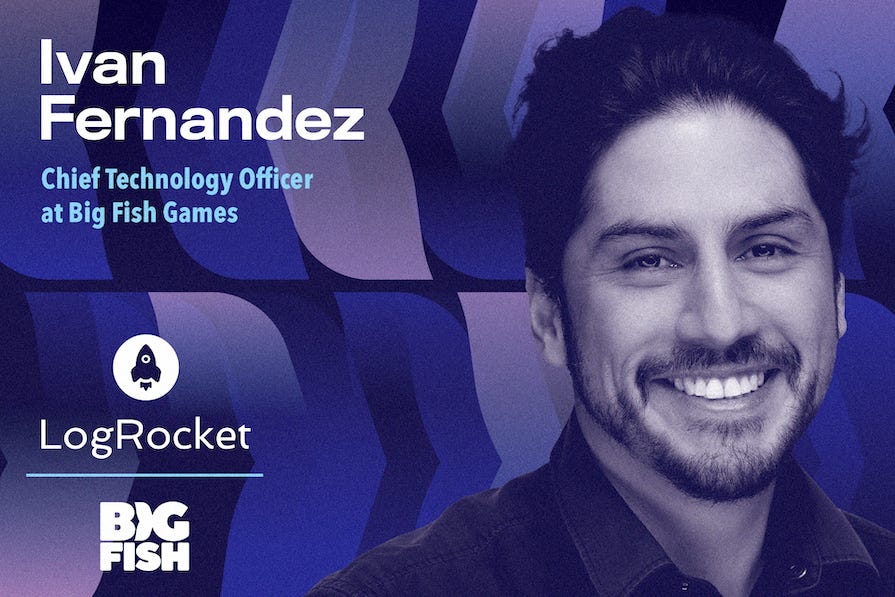
In our conversation, Ivan talks about AI’s role in game development — specifically, how it’s enabled game designers and artists to automate the tedious parts of their roles and focus their time and talents on creative work. He shares how changes in technology have increased players’ standards and expectations for games over time, as well as how his team analyzes behavioral data to improve the overall gaming experience.
AI as a tool, not a replacement
The use of GenAI in game development is a polarizing topic. What’s your philosophy on whether or not to use GenAI in the game-building process?
I see it as a tool that helps make the vision the artists have for the game come to life. It cannot be driven by AI alone — the creative part of the job belongs to humans. AI is really good at replicating things that it knows exist, but it cannot create worlds or images from nothing.
AI is a way for artists to test concepts, variations, and ideas. What works better and what works worse? What are ideas for different color schemes? With AI, they have a much broader toolset at their disposal to find the perfect balance in their art. It is not going to make artists go away — it’s just going to help them find that perfect scenario that they are looking for faster and easier.
At the end of the day, you need to go the extra mile after something is generated to get it to look exactly the way that you want. There are so many variations and nuances, and it’s never perfect. There’s always something the human eye can catch. That final process of review and post-generation always comes back to the artists to ensure that the output fits all the guidelines.
We do something very similar in engineering. AI can generate a lot of code, but we still have to check for things like security issues and understand how that specific piece of code plays into the bigger ecosystem. The last step should always be a human review of the work.
Do you ever train the AI on an artist’s unique style?
Some of the teams that I work with have made it so that a specific model can generate certain pieces of the game. It’s a way to get us 70 percent done by covering the tedious tasks. Even if AI is trained with the style of a specific artist, art evolves. The game evolves, as well as the artist’s style, palettes, and concepts. AI doesn’t know where the artist wants to take that game world moving forward.
We always want to do the repetitive, mechanical part of the job with the help of a tool. Then, teams can focus their time, brain power, and artistic talent on doing the other 30 percent. That’s the creative, interesting part for everyone.
Engineering teams, especially those focused on programming, spend a lot of time working on repetitive code. It’s not solving a problem. AI helps bridge that gap and make the part that is boring and repetitive faster. Then, you can focus on solving real engineering problems.
Fear that AI is replacing creative jobs is ubiquitous. As a leader, how do you acknowledge that fear while still encouraging your teams to embrace the technology?
With every new development, technology, and tool, there will always be fear because it’s not what we are used to doing. My teams are no exception. The best way to handle it is to be as transparent as possible about what we are trying to achieve. I like to be clear that, yes, there is fear around this, but I also reframe the use of AI as an instrument. It’s one more option that you have in your arsenal to solve problems or create new art.
The more you try different palettes, colors, or variations, test scenarios, or experiment with variations of code, the more you learn about what works and what doesn’t work. AI makes the process of learning faster.
When you put AI not in the driver’s seat, but next to it as a helper, people enjoy the interaction more. Once we get past the idea that it’s going to replace me and look at how it can help me learn more, not only do we embrace the change, but we can also look at different ways of using these tools. If we just resist, it becomes more of an emotional response than a rational one.
Managing increasing player expectations
You’ve been in the gaming industry for about 20 years. What new challenges and new failure points are emerging now that didn’t exist even five years ago?
One of the biggest challenges is that mobile technology has advanced really fast. The amount of processing power that you have on your phone today is mind-blowing. The number of things that you can do with that processing power is unthinkable compared to a couple of years ago.
That comes at a cost. People expect higher quality, better graphics, more content, interesting timelines, and a smaller barrier between traditional consoles or PCs and mobile. Nowadays, many of the games that you can play on mobile, you can play on a console or PC, and you can switch your devices seamlessly across all the different ecosystems. That makes the development of the games and the systems to support them immensely more complicated.
I’m a huge fan of all retro games, and I play Nintendo games often. Those games are beautiful in their simplicity. You can only do a couple of things in Super Mario. You can jump and run, but that’s about it. Now, games are expected to have cinematics, tutorials, daily missions, leaderboards, multiplayer, the ability to chat and play with your friends, seasonal content, tournaments, and more. All of those things have exploded, and so has the complexity of games in general. Players’ expectations are going up, and the time that it takes to develop these games goes up accordingly.
As CTO, how do you prioritize the development process to keep up with players’ expectations?
Just because player expectations are higher does not mean we can keep growing a gaming team infinitely or making the timelines longer. A few years back, creating a simple game for mobile would typically take a couple of months. Nowadays, it takes a minimum of one to one-and-a-half years if you want to have all the features.
From my perspective, we have to focus on better pipelines, workflows, and tools, and support our developers so they can do their work efficiently. I want to help them focus on what they should be doing, which is producing the game and making it fun.
This aspect is a little bit different from other software industries — there’s a hard-to-measure, fun quality to the game. The game can be beautiful, but if it’s not fun to play, people are not going to engage with it. The more time the team spends working on the fun factor of the game, the better. As CTO, that’s my goal. How do I make those pipelines and those workflows? How do I provide the developers of the game with as much information on what the players want in the fastest way possible?
Correlating data to improve the player experience
You’re constantly balancing cost with production speed. How do you evaluate whether a new piece of content will meaningfully impact retention before committing the full investment to build it?
Making games is not a deterministic science — it’s a form of art. You have to believe in what you are doing. The game designers and creative people on the teams all have to believe that what they’re making is interesting.
After that, there’s a lot of data analysis, A/B testing, pipelines, user testing, focus groups, and user and market research to understand how players are interacting with the game.
One of the key elements is iterating on everything that you do. Very rarely will the first version of something that you launch be perfect. You have to gather as much data as possible from players about what they like, what they don’t like, if they are happy with it or not, and iterate as fast as you can on making the game better. Part of the development philosophy is having the workflow, processes, and tools in place to be able to iterate fast for that environment.
Sometimes, you make mistakes. A feature that you launch is not well-received, and you have to go back to the drawing board to redesign. It happens. We try to minimize those cases with as much data as we can and by making as many informed decisions as possible.
What metrics do you rely on to determine whether a game feature is improving the player experience?
We look at engagement metrics and retention, including session length and the average number of sessions per day. We identify funnels where players are stopped or churning. For example, if we have a game with many levels, we may notice one place in particular where players are stuck or failing the most. That might be a sign of an error or imbalance in the game. If players are not going through the tutorial, there might be something in the onboarding that isn’t working correctly. Or, if players are not coming back to the game, there might be a problem with its content.
We track metrics around feature engagement, so if players are not engaging with a feature as much as we would like, there might be a complexity or accessibility issue. With so many metrics, we have to correlate them all, and there are a lot of very bright people on our team who look at it every day to understand player behavior, pain points, and where we can improve.
At the core of it all is data analysis. The data pipelines and telemetry that we collect about the games enable our analysts to make the right decisions based on the data. From a technology point of view, that’s the key element to operating a game efficiently and effectively.
Looking ahead, which technology shifts do you believe will have the greatest impact on how game studios build, operate, and scale games?
The first one is AI — not just in the way that we develop games, get content faster, or help artists generate art, but how we think about personalizing the game for a specific user. AI opens the door to personalizing players’ experiences more naturally. I think that’s something that we will see in a few years when the technology is a little more mature.
Further, there are a lot of areas we haven’t explored yet in terms of how AI can help build more immersive experiences. There’s so much potential for games to be driven by the players themselves, in a way that fits them and their personal taste.
The second area is how equipment has been evolving. The lines between what can be done in a PC versus a console, versus a phone will be blurred. I think they’ll become so blurred over time that we’ll be able to move seamlessly across experiences. That way, players will be able to keep the worlds they’ve built and take them with them at all times.
What does LogRocket do?
LogRocket’s Galileo AI watches user sessions for you and surfaces the technical and usability issues holding back your web and mobile apps. Understand where your users are struggling by trying it for free at LogRocket.com.