

Dani Tumbusch is Chief Technology Officer at Alamo Drafthouse Cinema, where she’s led a full-stack modernization effort — rebuilding the guest experience, replacing legacy POS systems, and modernizing core foundations behind the scenes while protecting the company’s culture.
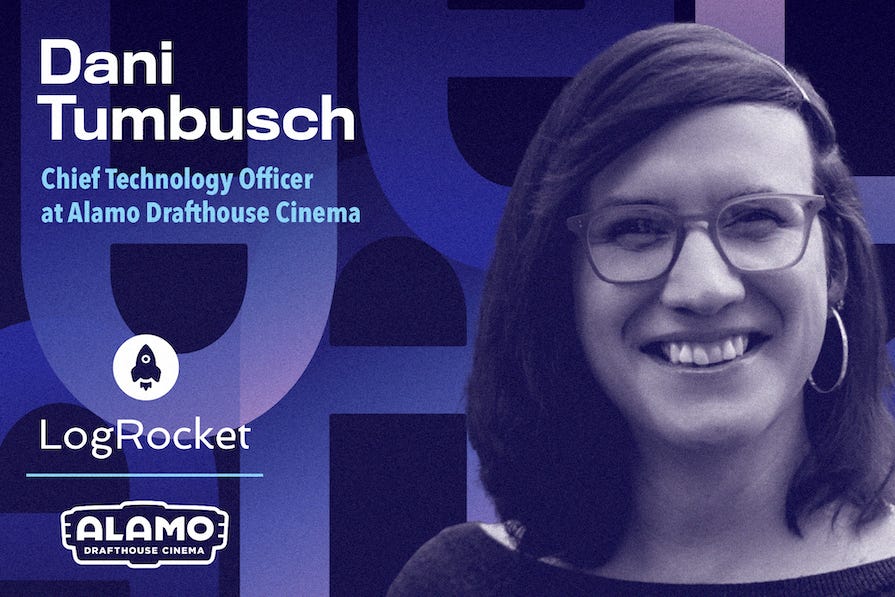
In this conversation, Dani shares what drew her to Alamo’s alternative-style, creative DNA, how she approached digital transformation under real constraints, and why culture — psychological safety, team autonomy, and healthy feedback loops — is the foundation for sustainable execution. She also unpacks how Agile (done without dogma) can function as a human system, not just a delivery system.
Bringing a culture-first lens to transformation
What drew you to Alamo Drafthouse and what did you sense about the humans there before you ever touched the tech stack?
Two things drew me. One, I have been a long-since-its-inception-term guest at Alamo. I’ve been going here since the first location on Colorado Street when it looked like a little abandoned building.
I have this false memory — and I know that it is false — but I think it paints a good picture of what Alamo was back then. I remember walking inside this concrete building with ragtag rows of cinema seats, and the founder Tim League serving my parents a beer, and everyone running around frantically. That’s real.
The false memory is that it felt so slapped together when it opened that I remember there was a bedsheet as a screen. And that’s not true at all, but I’ve implanted that image because it speaks to how scrappy it was to make this dream come alive.So the first reason for being drawn to Alamo was because I was a part of that. When Alamo randomly reached out three and a half years ago, it was an immediate, “Yes, I want to talk to you.”
Through my long interview process, I got to meet tons of humans from all over. Every conversation was a round-robin with lots of folks, and everyone just got to chime in and talk and ask questions. It was like this collaborative-interview experience.
After I accepted the role and I came here, I got to see that collaboration in action. I was extremely taken with how passionate this entire company is. Never have I worked at a company that is filled with creatives, and that creativity is infectious. Once I came through the door, I was like, “Oh, my gosh, this place is special, and it deserves cultivation.”
You were CTO at your previous company and were brought in to Alamo as director of engineering. How did you strike the balance between the right career move and right cultural fit?
My interview process was three months long. That gave me a lot of time to think and reflect about whether or not this was the right role for me. It was a very difficult decision leaving where I was, because I had been there six or seven years. I’d built a culture and friends — some I consider family. I cried for a week leaving that place.
I remember the moment where I made the decision. I came to meet everyone in-person. I got to go to the Alamo headquarters, the Baker Building. It’s an old school that was built in 1905.
The entire experience of driving up to this building, walking through the front doors, seeing the hodgepodge of artifacts everywhere, photos along the wall of all these moments in Alamo’s history, walking past these scary wax statues — it was surreal.
It was several hours of conversation. When I left that building, I had this overwhelming feeling that I knew that if I did not accept this role, even though it was a gamble and taking a lower position, I would regret it if I turned it down.
Modernizing under real constraints
You came in post-COVID with a mandate to modernize, but not the millions typically required to do it. How did that constraint shape your digital transformation strategy?
After COVID, the company was healing or trying to heal. It definitely was a time of healing. There was real interest in investing in technology, but there were a lot of questions. Afterwards, you’re already super lean because you’ve restructured everything, and everyone’s very focused on “is this the right thing for our business,” asking that question on every single initiative.
My approach was to first spend time getting to know how the company functions, how the business operates, what’s most important to the business. It was very obvious that it’s the venues. It’s the operations teams. It’s what makes the venues run.
When I spent time in the venues, it was fascinating to watch. When you see all the venue humans and teammates running around to make a day at Alamo happen, it ends up looking like a hive mind or an organism. The entire place functions. The servers and the staff in the kitchen — nobody talks to each other. They’re just doing it, and they’re making it happen.
Alamo does the thing that they say not to do — the cardinal rule of, when you open up a restaurant business, never seat everyone at once. So what does Alamo do? We put on movies and we seat everyone at once. So it’s waves of intensity as every movie starts, and the pre-show starts, and the orders start coming in.
When I stepped back and I looked at technology and how it needed to transform, where we would invest, the most important thing was very obvious: focus on the venues and ensure that any technology we change or inject does not disrupt that organism. It needs to enhance it.
So, help the venues now with everything that we do while also, in the background, work on subsystems and foundation. Spend the first couple of years focusing on the venues, and then we’ll also replace the website architecture.
How many venues are there?
Forty-four.
In the beginning of that transformation, how did you assess what needed to be fixed first?
That was easier for me because my background is in web development and cloud infrastructure, and architecture. My entire career has been on that side of the world. Naturally, I gravitated to: “Oh, I know this like the back of my hand. Oh, we’re using Angular 1.X. That is a problem.”
The web app experience and the native app experience are problematic if the frameworks that we use are antiquated and not flexible or extensible. They’re no longer secure because they’re several versions behind.
That story wasn’t just the web and app. It was pretty much all over the org in various permutations. In our venues, we were using an old version of Aloha in many cases. I think it’s pretty common for a lot of businesses post-pandemic: lack of investment leading up to it, then putting everything on pause.
Culture signals and psychological safety
When you step into an organization, what are the cultural signals that you look for?
The first thing I always look for: do people ask questions in meetings? Do they ask them in large meetings? Do they admit when they don’t know something in a public setting? Do I observe pushback? Are people challenging others in a healthy way?
I pay close attention to who speaks first in meetings, who stays quiet, and try to understand why. I also look at how failure is treated, especially in the technology org. I look at the mediums we use for communication and what the tone is. How do other leaders behave? Do they own mistakes or do they deflect them?
I don’t know that I have a list when I come into a company. It’s more that I’m sitting in meetings and observing to understand culture. Once I have a good grasp, I’ll start to dig in more and ask more questions.
I imagine bubbles around humans — how much influence they have and exert over their workplace or their team. Some people have big bubbles and some people have little bubbles. There’s no right or wrong. It can vary day-to-day. My role is to help those bubbles grow for those that want it, or at least feel happy and content and in control of their bubble and their sphere.
Culture always comes first. Psychological safety comes first: ensuring everyone feels comfortable speaking up, challenging each other, being radically candid with one another. If they’re not, that’s a big red flag, and then I dig in and work closely with people or teams to understand why.
Agile as a human system
What does Agile look like inside of Alamo today, and why is it so important from a human standpoint?
My team is so sick of me saying the word “Agile.” They have a dollar jar for every time I use a buzzword like that.
The focus, for me, is to not be dogmatic. Agile has gotten a bad rap, and you see countless posts like, “Agile is dead.” For me, they’re missing the point. It’s not scrum. It’s not Kanban. It’s not SAFe. It’s about building a process and embracing iteration that works for your organization. Not just iteration, but iteration and reflection. That’s the key.
At Alamo, it’s intentionally not dogmatic. We focus on principles, not necessarily process. We have multiple teams, and each team has a slightly different process. You could cherry-pick something and go, “Well, this team does Scrum,” but it’s not actual textbook Scrum. It’s some organic version.
Real retrospectives are extremely important to me. Every team should be talking about what’s not working well, what’s working well, and appreciating each other at some regular cycle. We embrace that roadmaps change. Alamo is very dynamic. This industry is very dynamic. We have to maintain an ability to change and agency for teams to make decisions and chase that thing without wading through tiers of approval.
One thing I’ll add: retrospectives and reflection tie into spheres of influence. Every iteration and every time they do a retrospective, everyone on a team is enabled and empowered to make a change to the process.
They may start as textbook Scrum on day one, but on day 365, through iterations worth of change, they have a completely different process that is wholly theirs. They all contribute and create it themselves. That’s the most important part.
Autonomy, morale, and a concrete example
How does giving engineers and product teams real say over their work change the quality of the work they do?
In terms of quality, I believe with my whole heart that morale equals quality. Happy and healthy humans equal quality. When I look at what an organization needs, I gravitate towards: are the humans happy and healthy? If not, how do we build something such that they’re happy and healthy?
People care more when they’re happy and healthy. There’s better decisions. When there is stress and crunch time, there’s more of a can-do, we-can-climb-the-mountain attitude that doesn’t exist if you don’t have happy and healthy humans and good morale.
Negative examples are fear and top-down pressure and rushed decisions. No company is impervious to that. What matters is not the moments but overall how it’s going, because we’re humans. Humans are messy.
Can you share a real-world example where the culture shaped the thing that was being built?
During our Toast migration, we moved from Aloha to Toast last year. We had an old version of Aloha. It wasn’t meeting our needs. We needed something more extensible and flexible and cloud-based, and we chose to go with Toast.
We started the project fully Agile. We broke it down into sprints. We planned iteratively and focused on learning as we went. Midway through the planning phase, the team pushed back. Honestly, I was surprised. I sometimes don’t like getting pushback unless they’re right, because I want to be right. I feel strongly: “This is the way.”
They were like, “Absolutely no, Dani.” They said, “For venue rollouts, what we need is something closer to waterfall.” The word “waterfall” is triggering for me. I get very “Ugh” when I hear it. But what they explained landed: 90 days out, these things need to be done. Sixty days out, these things need to be done. Thirty days out, these things need to be done. They wanted clear markers in the sand as they approached go-live dates.
My instinct was “small chunks iterate forever,” but they were right. The operational reality of the venues demanded structure and predictability. If they hadn’t challenged me in a public way, I would’ve forced them down the wrong model. I truly believe the rollout wouldn’t have gone as smoothly. It ended up being the smoothest technology rollout I’d ever been a part of, and I directly credit the success to that moment where the team spoke up and changed my mind.
That’s what I mean about culture. Psychological safety isn’t just a feel-good concept. It literally changed the outcome of a multimillion-dollar program.
Preserving what makes Alamo Alamo
How would you describe Alamo’s culture when you arrived? What did you preserve, and what did you reshape?
It was passionate. It was scrappy. It had a very strong identity. Alamo knows who they are for the most part. I thought it was important to preserve those pieces. It was also important to preserve the weirdness. Alamo is kind of weird. And weird can be really cool.
In our offices at Baker, there were wax statues everywhere and people would move them. I would come the next day and there’d be a new one in a new place in the basement or something.
Someone on one of my teams had these arcade machines filled with video games. I was told the manager at the time would hold kung fu game challenges. People would rally around these games to fight each other for the leaderboard. That kind of stuff was important to preserve — and anything that could lead to the creation of that kind of stuff.
Film first was really important to preserve. What I reshaped was ownership clarity. I wanted to make sure that everyone was empowered and they had correct ownership of their spheres — influence, control, trust.
I wanted everyone to get really comfortable with feedback. Psychological safety — I know I’ve said that a half a dozen times — and process and documentation.
Communication we’re still working on. When you’re super scrappy and creative and passionate, usually communication doesn’t get a grade A because you’re moving so fast. I try to publicly talk about the feedback I receive and what I’m doing to address it to set an example: “Hey, you can give me feedback.” And I will respond and act based on that.
Bottom-up culture and leadership influences
Can you build culture from the bottom-up instead of top-down?
This will be another put-a-dollar-in-the-jar moment: I learned all this through Agile principles early on in my career.
Beyond the mechanical pieces, what struck me was going through retrospectives: give feedback on how something is going, make a change, and realize I can change this thing over time. It’s shaped by thousands of little tiny cuts over time. That struck me as incredible back then.
As a team leader, you’re bottom-up. You can’t influence a company at a big level like that. But if you get multiple teams working in concert to do reflection and change things over time, then you effectively can change culture in a positive way for a company from the bottom up at a team level.
The first time I got to put that theory to the test was at my previous company. Culture was blaming, fear-based, toxic, pointing fingers. Since I’m not an executive leader, how can I shape culture? I focused on establishing reflection, spheres of influence, and cultivating those from the bottom up.
Over time, two years, I noticed a huge shift. That came with hiring new folks and empowering some of the humans that were there. Those that weren’t here for the model of happy and healthy humans, they left on their own. They noped out of it.
That’s how I feel anyone at a management level can influence culture: make sure teams can shape their own cultures over time, and they have senses of ownership and influence in their daily life.
What are the major influences that have shaped your thinking about leadership?
Radical Candor by Kim Scott. I try to make everyone that reports to me read it.
The other one that shaped the bottom-up idea was The Advantage by Patrick Lencioni. It was required reading when I was at Autodesk. I remember sitting on a plane and reading it, and it all clicked: vulnerability, emotion, organizational health, retrospectives, spheres of influence, ensuring happy and healthy humans.
The biggest takeaway was the culture vulnerability part. All teams need vulnerability, not just executives.
Knowing the system is working
How do you know when the system is working?
The biggest thing is that people begin to speak up, and they feel comfortable speaking up, and it’s not toxic. There’s a shared understanding of assuming positive intent. When someone says, “I think that’s a bad idea,” people aren’t afraid of hearing that. There’s less insecurity. People come away not feeling targeted.
When I know it’s working is when people challenge me more and they’re not upset when they are wrong, and I’m not upset when I’m wrong.
Other indicators: mistakes are surfaced easily. There’s a real understanding of, “Oh, no, that was a mistake. Let’s all go this way instead,” and you’re not spending a lot of time on the mistake. The mistake doesn’t get regurgitated multiple times. Honest retrospectives and a diminished hero culture are also signs the system is working.
The biggest marker for me is when the company is moving at a sustainable pace. That one is really hard. That’s years of maturity. That’s the north star.
“Slow is smooth, and smooth is fast.” I believe in that. If you can slow down enough to be smooth, then you will always go faster.
What does LogRocket do?
LogRocket’s Galileo AI watches user sessions for you and surfaces the technical and usability issues holding back your web and mobile apps. Understand where your users are struggling by trying it for free at LogRocket.com.