

Chad Greiter is Director of Digital Product at Simon, a real estate investment trust engaged in the ownership of premier shopping, dining, entertainment and mixed-use destinations and an S&P 100 company. Chad began his career working in web design and development at several startups. He later transitioned to the agency side of the house, serving in various development and project management roles at QScend Technologies and Agency Labs. Before his current role at Simon, Chad held technology leadership positions at General Mills (Blue Buffalo) and Edgewell Personal Care.
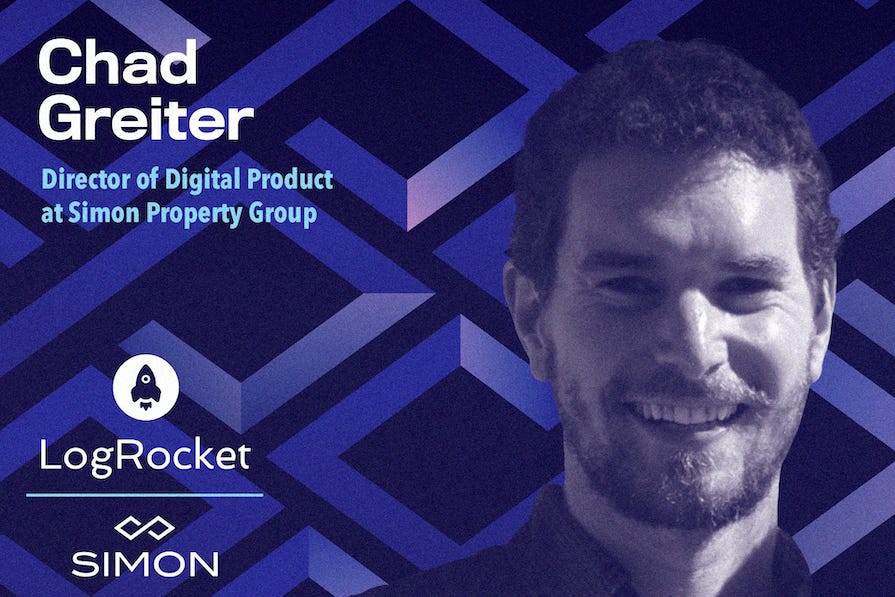
In our conversation, Chad explains how Simon is reshaping omnichannel shopping in malls through a unified physical-digital ecosystem, highlighted by the new Simon+ loyalty program. He describes how his breadth of experience from his generalist career path spanning development, UX, marketing, and product helps him manage scope, spot risks early, and build real cross-functional buy-in. Chad also shares how Simon validates consumer experiences across various properties and shopper types, tailoring testing and personalization by channel and center-level personas.
Working in digital convergence
Throughout your career journey, you’ve worn several hats, working in frontend development, UI/UX, and, now, product. How has that broader background been helpful in your current role?
The concept of digital convergence is big for me. We all use websites and apps daily and get to see what works and what doesn’t in blended physical-digital experiences. As product leaders, our goal is to deliver something seamless with the right feature set. Success comes from the ability to design a product that meets unique user, or in our case, shopper and tenant, needs across all channels. Having a diverse career journey has helped me pull the right experiences forward for use today. Having worked in frontend development, I can “talk the talk” when it comes to establishing tech requirements through a product lens. I can put myself in other people’s shoes, and that’s been super helpful.
As someone with a “jack of all trades” career path, you learn to effectively manage scope and win buy-in across wide stakeholder groups since you’ve been part of so many of them. This doesn’t always come easy in complex organizations where there are deeply rooted business rules and context, but over time, I’ve learned to offer a grounded perspective that factors in the many needs of a product. Each functional marketing area is going to need support in a different way. The ultimate stakeholder for our products is the end user, but it’s just as important to keep comms wide open across the entire business or else our growth tactics will ultimately fail.
That prior experience helps me catch things early on that others might miss. This could be technical challenges that need legal vetting or identifying media impact before rolling an anticipated UI/UX change. I’d encourage entry-level product people to raise their hand on as many peripheral tasks to their work as they can to gain this type of experience. Even better when the tasks are outside of their area of expertise.
Do you find that the best product leaders come from a generalist background?
Not necessarily, but I think it might help. I think this is highly dependent on the org structure and products the PM is working on. Having an eagerness to learn and get exposure to different areas of the business will create better product leaders. Coming onto a team in a junior product role, one might think there are rigid frameworks to follow, but after almost 15 years in the digital space, I can confidently say that most of it is fluid. It is easier to navigate complex problems when you have a diverse digital background.
We also collectively benefit from product people who deeply focus on one area and that really comes down to the product org and how niche a product is. I would imagine some fintech and other highly regulated gov spaces benefit from prioritizing niche expertise. My own personality and style of work lend much better to the idea that I can go learn something, add it to my arsenal, and then move to another critical area where I’m needed.
Thinking like a generalist
How does your ability to put yourself in other’s shoes benefit end users?
It bleeds into the product in a good way and really benefits all marketing channels. When we look at mobile apps, websites, or physical space solutions, it’s critical to be on the front lines receiving both customer and internal feedback, grounding decisions in data. I think having experience in multiple functional areas serves well when working at the rapid pace of today’s digital expansion. It also acts as a good hedge against any myopic or group think patterns. Go get the buy-in across all business areas, leverage peer expertise, and translate that to the ultimate customer experience. If you come straight in without doing the groundwork to understand other’s needs, you won’t have a well-informed perspective.
Is there an example you could share of a time where you were able to identify a blind spot or a risk that someone with a narrower background might have missed?
I’ve been involved in some major re-platforming decisions that had heavy agency involvement. Agency recommendations are valuable but it’s critical to test out alternative viewpoints that are grounded in perspective from those inheriting long term maintenance of a platform. I try to read the tea leaves and identify biases for a particular recommendation. I think this approach goes without saying, but it’s honestly surprising how often I’ve seen recommendations go unchallenged without proper due diligence.
Rather than get too caught up in the product or tech decision at hand, I try to take a step back and collect feedback from peers. When it comes to re-platforming decisions specifically, as a good leader in that space, you want to get the answers from all functional areas that are using a platform and build strong, formulated opinions.
In a previous role, I challenged a major multimillion-dollar decision to shift to a new agency-recommended DXP/CMS. The initial decision was driven by a desire to consolidate all tech under a top SaaS provider, but we hadn’t fully teased out the pros and cons. I did research in each functional area and had strong conviction to offer up a dissenting POV. The new CMS would have provided great platform consolidation and helped with advancing headless content architecture, but we were not at the stage to deploy that content across our existing marketing channels anytime soon. We would have been left with a hefty price tag for something we’d only begin to realize gains on in 1-2 years. This meant taking a step back and staging our SaaS expansion in crawl/walk/run phases. We would still move in that direction but scale appropriately with a proper roadmap.
Since this was in a martech-heavy role, I might have defaulted focus on the technical stack, and most certainly would have come up with a better architecture, but we wouldn’t have been ready to use it in any meaningful way. My previous experience as a homegrown CMS business user and UX designer, meant I had built templates and taxonomy in the past and had a unique perspective that ultimately drove a better product decision. I can contribute most of that knowledge to past experiences wearing many hats.
After you communicated your concerns and advocated for considering other options, what was the course of action?
In a way, it opened an internal think tank. We pulled together a working group of individuals who hadn’t been heard. We went below the executive level steering committees and collected feedback from the lower/middle rungs of critical functional areas. Once I got the necessary feedback supporting an alternative viewpoint, I packaged it up for leadership. The working group helped us gain a better understanding of what was involved for the hands-on knowledge workers doing the work and helped us realize that we needed stronger representation across the board.
Testing across different customer segments
Product, like many functions, has certainly been affected by AI. What advice would you give to folks who are at an earlier stage in their careers and may be concerned that their expertise won’t be valued?
We’re in a very delicate time. I augment my work with AI tools, but still have daily questions about what is good AI practice for today vs. a few years down the road.
I’ve seen many alarmist narratives about AGI taking tech and product roles, but what I’ve seen myself and through feedback from other tech peers, is that AI tools are not ready to do the critical thinking. Our obligation is to experiment with and augment our work with these new technologies where it fits well. A good approach is to ask, “How can I cut 10 or 20 percent of my time that’s currently being spent on admin tasks and get time back to create value in our product?”
That seems to be the lowest-hanging fruit. The advent of agent building, SaaS admin agents, and the wealth of knowledge one can gain through copilots is exciting. I think agent orchestration is the next big thing in the product space but needs a little more time to mature. There’s been a rush by big tech to deliver the tools, but I still see lots of limitations in my own AI workflows. That being said, amazing connector products are being rolled out every day, and I do think this means we can spend more time creating and ideating vs. just managing a book of ever-expanding SaaS platforms.
My advice to a junior product manager would be to raise your hand, experiment, and be thoughtful about communicating to leadership about where AI is helping and where it is not. There is a lot of pressure to use GenAI or risk getting left behind but not all use cases are production-ready and that is perfectly fine. The key, I think, is to find spots where AI tools do good work, like prototyping UI before it gets to development or helping with requirement gathering. I would 100 percent recommend using those tools today. Figma and Notion’s AI products have been a huge help in this space.
Simon has been a mall operator for over 65 years. At a high level, how do you think about providing a consistent experience across the whole digital footprint, from websites, apps, or mall kiosks, and also meet the unique needs of each use case?
I think all digital teams face challenges when delivering across so many marketing channels. We all saw companies struggle to adapt when forced into the digital space during COVID, but that’s never been the case for Simon.
Simon has put the shopper first, both in physical and digital space well before the biggest loyalty and digital-first pushes have happened. There is relentless focus at Simon to meet the shopper where they are and offer the best incentives, whether in-person at one of our centers or through our web and app experiences. The concept of digital convergence and omnichannel excellence is at the core of all our decisions.
We have always driven strong in-store shopping and brand awareness through our data-enriched websites, app, and digital directories, as well as through Simon Search, which lets shoppers browse products online or through onsite directories, to quickly and easily find what they’re looking for, both in-store and online. This robust channel development helps us cater to every shopper persona.
This year we also launched Simon+, a first-of-its-kind loyalty program delivering rewards wherever they shop with cash back, points and perks for shopping at Simon centers or online at ShopSimon.com. The program has a simple, always-on platform where members can access exclusive offers, receive cash back and points for qualifying in-store and online purchases, and unlock curated rewards. This new program is designed for today’s modern shopper.
To deliver a unified message to shoppers across online and in-store shopping experiences, we focus on our user feedback loops and leverage best-of-breed session recording and analytic tools. We have a good pulse on the Simon shopper, but keeping an active check on a user’s digital vs in-store affinities is critical. It’s sort of a push-pull. What works on one channel doesn’t work everywhere, so we are very thoughtful and intentional about our approach. For example, we recently underwent a redesign to simplify the UI and UX on our digital directories at each center.
The user journey on the touch-screen directories in centers now prioritizes quick search and browse actions with minimal touch or typing required. The UI/UX decisions came from in-person testing and frequent iteration based on our event-driven analytics layer. The filtering needs and use of critical UI real estate will never be the same compared to our web/app experiences. We took our strong underlying center and store taxonomy and reduced the features and content accordingly without sacrificing relevancy.
I would imagine that the shopper personas for individual stores within a Simon property can be quite different. How do you approach testing those different customer segments?
We can derive good insights from a given shopper segment and link it back to a shopping story rooted in the specific center they’re visiting. Simon properties range from regional malls to luxury shopping destinations, so it’s not one size fits all. That means our product strategy must be highly adaptable.
There’s a wide range of shopper personas, and we try to meet each one where they are through personalized offers and content. With a deep analytics layer using an event-driven architecture and a healthy amount of business rules, we deploy template-specific changes depending on the center and store to account for shopper preferences and demographics. We still need to be thoughtful on the strategy side, but deep segmentation capabilities are now available and in use in an automated fashion within our SaaS platforms.
Analytics doesn’t always provide the complete picture, though, so leaning into qualitative feedback and user testing is key here, especially in a scenario such as anonymized users interacting with our digital directories.
Redefining omnichannel and loyalty programs
Simon recently introduced the Simon+ loyalty program. Could you describe this omnichannel loyalty program and explain why it was developed?
Yes, of course! Simon+ is unique because it offers our new loyalty program that brings cash back, points, perks and exclusive offers both in-center and online at ShopSimon.com. We pull it all together into a frictionless experience and have such diverse rewards, which means every shopper has something to love. Who else offers points, not just for retail purchases, but also for food court visits?
With Simon+, you can earn cash back, points redeemable for rewards, as well as exclusive offers from 500+ of your favorite brands. To me, this is what omnichannel success looks like. There’s no fragmentation or need to use multiple different apps to feel like you’re getting the best deal. If you were already planning a trip to one of our premier shopping destinations, why not save money in the process?
As use of the Simon+ program scales up, our engagement data, and peripheral Shop.Simon.com marketplace and Simon Search aggregate data all feed into better recommendations for our shoppers. We’re going from scheduled to real-time activation.
As you think about the next phase of digital growth for Simon, are there any particular technologies or integrations that you view as critical for scaling and growing even further?
We are focused on platform-driven personalization since there are endless possibilities there. The foundational work we’ve done allows us to serve dynamic customer journeys based on user preferences and actions.
What does LogRocket do?
LogRocket’s Galileo AI watches user sessions for you and surfaces the technical and usability issues holding back your web and mobile apps. Understand where your users are struggling by trying it for free at LogRocket.com.