

Ali Tahmasbi is CPO at Instil, a relationship management platform for nonprofits. He began his career as a corporate finance analyst at IBM before transitioning to a business analyst role at QDSC. From there, Ali spent over seven years at MySpace, one of the defining platforms in the nascent days of social media, shaping the product during the pivotal years when the industry itself was still being invented. He has co-founded two companies, Sportle and Backpack, and served as an executive producer at Saatchi US before joining Instil.
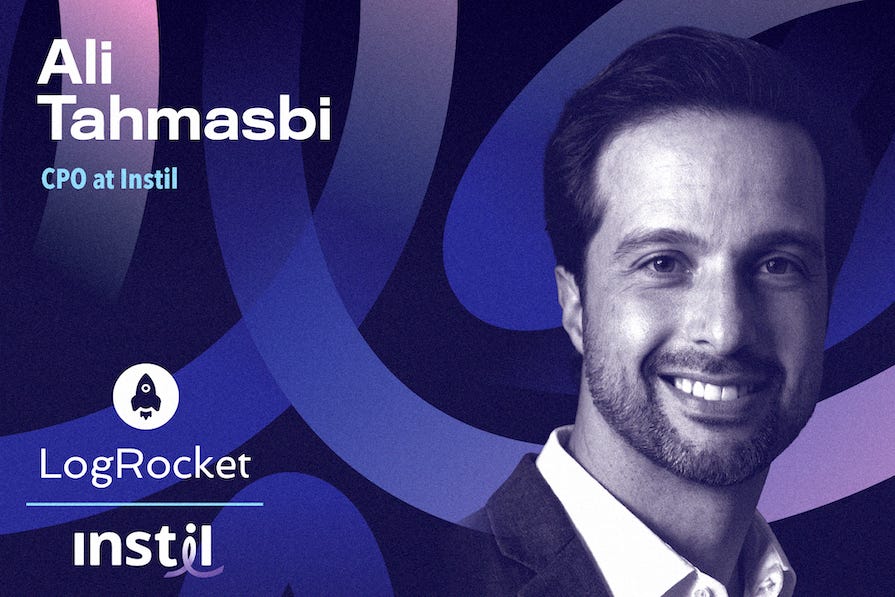
In this conversation, Ali talks about what it means to operate in a compressed product lifecycle, where the time between idea and delivery has shrunk dramatically. He shares how AI has removed traditional bottlenecks and fundamentally changed how the traditional product trio works together. Ali also discusses the growing importance of identifying the right problems with product intuition, moving from historically opinion-driven to evidence-driven decisions.
How AI is reshaping the product lifecycle
How would you describe the pace of a product lifecycle today compared to even just a few years ago?
The biggest change with the advent of AI is that it’s collapsed a lot of the steps that would go into a traditional lifecycle — the time it takes to go from an idea to a prototype or customer-facing concept, and then to a product. I can create something viable in a matter of minutes to show a customer. Back in the day, that used to take a long time.
It also used to involve a lot more organizational bureaucracy — securing resources, making a case for what we’re doing, getting the right people aligned. Much of that has fallen away. With this compressed lifecycle, the process isn’t just faster; it has fundamentally changed. Product, design, engineering, and even marketing can now work in parallel instead of waiting on each other. We saw a shift from waterfall to agile, but even agile is starting to feel less central. What matters now are the core principles: taking in feedback, learning quickly, and prioritizing the right problems.
That’s the key — figuring out what the right problems are. Doing everything for everyone doesn’t work. You need a clear point of view on where you can create the most value, while staying flexible enough to evolve as you learn.
You spent over seven years at MySpace during a pivotal era in social media. What did managing a product lifecycle look like back then, and how much of that process was shaped by the sheer time it took to build, ship, and learn?
It was a bit crazy — it felt like three jobs. I often joke that working at MySpace was like college, grad school, and a medical residency for product management.
Back then, the lifecycle had a lot more drag. Even though MySpace still operated with startup energy, we were dealing with multiple management layers and had to sort out resources just to do any meaningful prototyping. After News Corp acquired MySpace, that added even more structure, oversight, and priorities from a public company. Internal politics and bureaucracy created long gaps between idea and implementation. It took time to test something, build it, and get it in front of users. We had great tools, but the organizational side slowed things down.
Even when trying to decentralize decisions, the weight of the organization made it difficult. A lot of the process was shaped by how long it took to navigate that. Today, we can create evidence before committing. We can prototype quickly and validate ideas with customers in days instead of weeks. For example, one of our product leads identified a pain point, created a prototype, and set up a customer conversation within three days. That step alone would have taken weeks before. She didn’t need to secure resources or go through layers of approval — it simply happened, and with very little friction.
When you compress the product lifecycle this dramatically, customers feel it too. What does the faster loop actually deliver for the customer who’s waiting on a solution to a real problem?
One of a business’s greatest advantages is the ability to reduce waste. At Instil specifically, we’re not spending a lot of time, resources, or money going in directions that don’t provide value back to the business. That’s huge.
We can learn faster, build things that provide value quickly, and, as a result, realize that value as a business sooner. This allows us to be more efficient, stay focused, and ultimately grow. We call our customers partners here at Instil, and for them, the key benefit of partnering with us is our responsiveness. For example, the time between our product lead identifying a pain point, talking to customers, and seeing a potential solution can be a matter of days.
From our partners’ perspective, that feels great. They feel that we’re listening, and the distance between experiencing a problem and us shipping an improvement is shrinking.
From opinion-driven to AI-powered product development
At a company like MySpace, how much did product direction depend on leadership having the loudest voice in the room?
In the early days, leadership had a strong influence. Tom Anderson — everyone’s first friend on MySpace — was deeply embedded in the community. He quite literally lived inside the community that he founded and built, and he became the voice of the user, which worked well early on.
But that doesn’t scale, and we learned that over time. In the early days, that can be really powerful, especially for a startup. And it’s not just a MySpace thing; many companies — startups and large organizations alike — are often shaped by loud voices from founders, executives, or board members.
The challenge historically was that pushing back with evidence used to take too long and required too many resources. By the time you gathered enough data, the opportunity was gone. Today, you can create that evidence quickly. If a leader has a direction, you can test alternatives, talk to users, and present a case before decisions are locked in. That creates a more collaborative environment where you’re solving problems together instead of following opinions driven by conviction alone.
At Instil, how is AI changing the way your team moves from identifying a problem to putting something in front of a customer, and what does it demand from them from a skills perspective?
We’re leaning into tools that help us synthesize customer feedback quickly. We can spot patterns faster, explore solution directions more effectively, and get to something tangible much sooner.
In one case, we presented multiple directions to a customer and ultimately ended up choosing a third direction based on feedback. That kind of iteration used to happen much later through A/B testing or feedback channels. Now, we can get there in days without having to build out the full end-to-end product. It’s quite empowering, and it reduces waste in terms of money and effort.
This demands strong product intuition. You have more inputs, more data, and more possibilities than ever. The challenge is identifying the signal in the noise. You need to understand which problems matter and create clarity for the team. Building is easier now. Choosing what to build is harder.
You said that knowing what to build is more important than ever. How do you validate the feedback coming in?
Synthesizing the feedback and identifying the pain points — the signal from the noise — is the most critical part. On our team, we often say we never want to lead the witness when we’re gathering feedback. You have to be somewhat scientific about it — understanding what the analytics and test cases are actually telling you, while staying grounded in customer conversations.
How can you go through this process without injecting your own assumptions? How do you take the data and make informed decisions?
Getting feedback is critical, but it’s even more important to define and identify the signals that are going to help you choose what to build. In the past, you had time to process feedback slowly. Now everything moves faster, so the skill is in interpreting information quickly and using it to drive clarity and guide better decisions.
One advantage for us as a startup is that we’re a lean team. That makes things easier in some ways, because we can adapt faster. This is especially challenging for larger organizations, but it’s also becoming a forcing function — they need to operate more like startups if they want to stay ahead.
When you’re moving fast, how do you make sure that you’re still doing real discovery and building feedback loops into your roadmap?
I define real discovery as information that helps us make decisions and removes uncertainty. It should actually change decisions based on what we’re learning. That still includes conversations with customers, and increasingly through prototypes, analytics, and evaluations. Tools like LogRocket play a big part in that, especially with products like Ask Galileo. The key is to preserve learning as a discipline, and, as things change and improve, take it in, synthesize it, reduce the noise, and identify the signals.
Feedback loops are no longer structured checkpoints. They used to feel more like a segment of the process, whereas now they’re constant. Information is coming in all the time — like a fire hose. The hard part isn’t collecting all that feedback; it’s interpreting it. That has to connect to how we think about process. Even with agile development, the process can’t be as rigid anymore. Planning has to be flexible, and the roadmap, as a living, breathing document, is constantly being shaped by what we’re learning.
This is where the human element really matters — how we juggle all of this, identify the signals, and understand what actually matters for the business. It also means leadership has to be aligned, because the team needs clarity on how to absorb new information and act on it.
Evolving with the PM role
You mentioned strong product intuition. There is real fear in the product community that AI is going to do away with PMs altogether. What does AI still fundamentally not replace in the product process?
Along with product intuition, also judgment. Those are core human components that this role will always need. AI can absolutely accelerate discovery and execution, but it doesn’t decide which problems matter the most, what tradeoffs are worth making, or what kind of experience is worth creating. That still requires human judgment.
AI will take over a lot of the drafting and coordination work — PRDs, documentation, and process tasks. But it doesn’t eliminate the role; it evolves it. I’ve heard Marc Andreessen talk about how the lines between the triumvirate of product development — product, design, and engineering — are going to blur, and that resonates. PMs will do more prototyping. Designers will do more product thinking. Engineers will have even more influence on product direction. You’re still responsible for the outcome, but how you get there changes.
So, for product people, the key is being open to learning and evolving the role. The responsibilities don’t go away — they become more judgment-intensive, more cross-functional, and more outcome-oriented. The role survives, but the bar gets higher.
For PMs who are feeling more anxious than excited about this AI transformation, what’s the mindset shift you would encourage?
I can tie this directly to how I used to think when I started my career. I remember setting goals for myself, and a lot of what I judged and measured myself against was how I got things done — how I worked with different teams, set up processes, presented to different audiences, and even things like writing documents. A lot of that work is going to be absorbed or compressed by AI.
The mindset shift I’d encourage is to focus much more on the quality of your thinking, as well as the speed at which you and your team can learn. How much can you improve outcomes for the entire team, not just yourself? At the end of the day, you’re still shaping better product outcomes, and that’s a much more important measure of success. Great product leaders make their teams better.
You also need to become more hands-on and more experimental. Be fluent across disciplines — data, engineering, design, marketing, operations, and everything that’s related to the business. If you’re acting like the CEO of your product, then all of these elements come into play. You need to think about them all collectively.
And maybe most importantly, there’s so much noise around us. One of the most valuable things product leaders can do is drive clarity through that noise. Product can do that exceptionally well.
What does LogRocket do?
LogRocket’s Galileo AI watches user sessions for you and surfaces the technical and usability issues holding back your web and mobile apps. Understand where your users are struggling by trying it for free at LogRocket.com.
Great article